

Screening tenants for premium properties is a structured due diligence process that verifies identity, financial capacity, rental history, and risk profile before a lease is signed. In the property management industry, this is formally called applicant screening or tenant verification, and for high-value rentals it demands a higher standard than a standard residential application. Tools such as ResidentScore 3.0, tenancy database checks, and income verification via payslips or bank statements form the core of any credible process. South Australian landlords must also observe the Privacy Act 1988, the Residential Tenancies Act 1995 (SA), and SACAT dispute procedures when making and documenting screening decisions.
What are the essential criteria for screening tenants in premium properties?
Screening high-end tenants starts with defining your eligibility thresholds before a single application arrives. Property-class calibrated criteria set the standard: for Class A luxury rentals, a ResidentScore of 700 or above and an income-to-rent ratio of at least 3.5 times the monthly rent are the benchmarks. Writing these thresholds into a documented policy before advertising protects you legally and removes subjectivity from every decision.
The documentation you collect must cover five areas:
- Identity verification: Government-issued photo ID (passport or driver's licence) and proof of legal right to reside in Australia.
- Financial solvency: Payslips from the last three months, bank statements showing consistent income, and for self-employed applicants, the most recent tax return or accountant's letter.
- Rental history: Written references from at least two previous landlords or property managers, including contact details you can independently verify.
- Tenancy database checks: A search of the National Tenancy Database (NTD) or TICA to confirm no prior listings for rent arrears, property damage, or lease abandonment.
- Credit assessment: A housing-specific credit score such as ResidentScore 3.0, which weights rental behaviour more heavily than a standard consumer credit report.
NSW Government guidance confirms that best practice across Australian jurisdictions focuses on confirming identity, payment capacity, and likelihood to maintain the property. This framework applies equally in South Australia.
Pro Tip: Never ask applicants to pay for their own credit check. NSW guidelines explicitly flag this as a compliance risk, and it signals poor process management to quality applicants who have other options.

Consent is non-negotiable. Every applicant must sign a written consent form before you run any background or credit check. Your application form should state clearly what data you will collect, how it will be stored, and who will have access to it.
How to conduct background and reference checks for high-end tenants
A thorough background check for premium rental applicants follows a defined sequence. Skipping steps or running checks out of order creates gaps that can cost you a tenancy dispute or a poor-quality lease.
- Confirm identity first. Cross-reference the name, date of birth, and address on the application against the government ID provided. Any discrepancy requires clarification before proceeding.
- Run a tenancy database check. Search NTD or TICA for prior listings. A listing does not automatically disqualify an applicant, but it requires a written explanation and supporting documentation.
- Obtain a credit or ResidentScore report. Use a housing-specific scoring system where possible. A general consumer credit report misses rental-specific risk signals that matter most for premium properties.
- Verify income independently. Contact the employer directly using a number sourced from a public directory, not the number provided by the applicant. For self-employed applicants, request an ATO income statement or accountant's letter.
- Conduct criminal history screening. HUD-style guidelines require an individualised assessment rather than a blanket denial based on any criminal record. Assess recency, nature of the offence, and evidence of rehabilitation. Document your reasoning in writing.
- Contact previous landlords directly. Ask specific questions: Did the tenant pay on time? Did they report maintenance issues promptly? Would you lease to them again? Vague or evasive answers are as informative as negative ones.
- Apply criteria consistently. Every applicant for the same property must go through the same sequence using the same documented thresholds. Inconsistency creates discrimination risk and weakens your position in any SACAT dispute.
Third-party tenant screening services reduce the administrative load and provide audit trails that are difficult to replicate manually. For landlords managing multiple premium properties in suburbs such as Unley, Burnside, or Glenelg, outsourcing this step to a professional property manager is the most defensible approach.
What legal obligations apply to tenant screening in South Australia?
South Australian landlords operate under the Residential Tenancies Act 1995 (SA), the Privacy Act 1988 (Cth), and the Equal Opportunity Act 1984 (SA). Each of these creates specific obligations during the screening process.
Key compliance requirements include:
- Consent before checks: You must obtain written consent before accessing any credit report, tenancy database, or criminal history record. Running a check without consent breaches the Privacy Act.
- Data minimisation: Collect only the information you need to assess suitability. NSW guidance on data limits confirms there is no obligation for tenants to provide consumer credit reports, and landlords cannot compel their production.
- Adverse action notification: If a screening report contributes to a decision to decline an application or offer less favourable lease terms, the applicant must be notified. Adverse action notices must include the name and contact details of the consumer reporting agency used and inform the applicant of their right to dispute the report within 60 days.
- Non-discrimination: The Equal Opportunity Act 1984 (SA) prohibits decisions based on protected attributes including race, sex, disability, pregnancy, and marital status. Screening criteria must be objective, property-related, and applied uniformly.
- Record retention: Keep all application documents, consent forms, screening reports, and decision records for a minimum of three years. These records are your primary defence in any SACAT proceeding.
Adverse action notices are not optional. Integrating them into your screening workflow from the outset, not as an afterthought, is the difference between a compliant process and one that exposes you to statutory penalties.
The adverse action notice workflow must be treated as a standard step, not a reactive measure. Build it into your application management system so it triggers automatically when a decision is made.
What practical steps build an effective screening process for premium properties?
A repeatable, documented screening workflow is the foundation of the premium property rental process. The following framework applies to properties across Adelaide's premium rental corridors, from Norwood and Prospect to North Adelaide and Henley Beach.
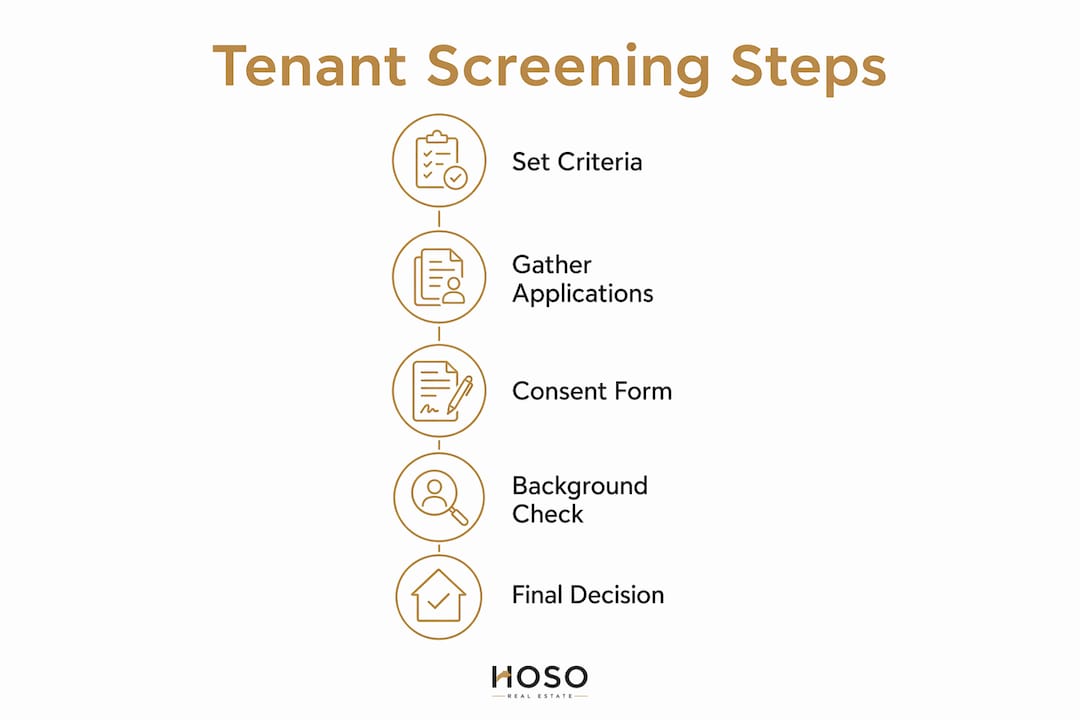
| Step | Action | Timing |
|---|---|---|
| Set written criteria | Document income thresholds, credit score minimums, and reference requirements before advertising | Pre-advertisement |
| Publish application requirements | State required documents in the listing so unqualified applicants self-select out | At listing |
| Collect standardised applications | Use a consistent form collecting only permissible data | At application |
| Run screening checks | Identity, credit, tenancy database, income verification, criminal history | Within 48 hours of application |
| Refresh reports as needed | Credit and eviction reports no older than 30 to 60 days; criminal checks within 60 to 90 days | Before final decision |
| Document the decision | Record the objective criteria applied and the outcome in writing | At decision |
| Issue adverse action notice if required | Send to declined applicants with CRA details and dispute rights | Within 24 hours of decision |
Applicant interviews and property inspections serve as a secondary filter. They allow you to confirm that the person presenting matches the application, and to assess how they engage with the property. A prospective tenant who arrives late, is dismissive of the property's condition, or cannot answer basic questions about their employment is providing useful data.
Pro Tip: Set a data freshness policy and enforce it. Outdated screening reports are one of the most common causes of poor tenancy decisions. A credit report from four months ago does not reflect the applicant's current financial position.
What are the common pitfalls in screening tenants for premium properties?
Premium property owners make predictable mistakes in the screening process. Recognising them in advance is the most direct way to avoid them.
- Relying on subjective impressions. A well-presented applicant who cannot verify income at 3× rent is a financial risk regardless of how they present at inspection. Written, objective criteria applied consistently are the only defensible basis for decisions.
- Using stale reports. A credit check run three months before the lease start date may not reflect a recent job loss or debt default. Enforce the 30 to 60 day freshness rule without exception.
- Skipping adverse action notices. Many landlords decline applications without formally notifying the applicant or documenting the reason. This creates legal exposure, particularly if the declined applicant believes the decision was discriminatory.
- Failing to verify income authenticity. Payslips can be fabricated. Contacting the employer directly and requesting an ATO income statement for self-employed applicants closes this gap.
- Applying a blanket criminal history policy. Denying all applicants with any criminal record is not compliant with fair housing principles. Individualised criminal assessments that consider recency and rehabilitation are both legally required and more accurate.
- Not adapting thresholds to property class. A 2.5× income-to-rent ratio may be adequate for a standard rental but is insufficient for a premium property where vacancy costs and repair costs are significantly higher. Calibrate your thresholds to the asset.
Key takeaways
Effective screening for premium properties requires documented, property-class-specific criteria applied consistently across every applicant, supported by verified income, tenancy history, and compliant adverse action procedures.
| Point | Details |
|---|---|
| Set criteria before advertising | Document income thresholds and credit minimums specific to your property class before the first application arrives. |
| Use housing-specific scoring | ResidentScore 3.0 weights rental behaviour more accurately than a standard consumer credit report for tenancy decisions. |
| Enforce data freshness | Credit and eviction reports must be no older than 30 to 60 days; criminal checks within 60 to 90 days before a final decision. |
| Issue adverse action notices | Notify declined applicants in writing with consumer reporting agency details and dispute rights to maintain legal compliance. |
| Document every decision | Retain all application records, consent forms, and screening reports for at least three years as protection in SACAT proceedings. |
What HOSO Real Estate has observed about premium screening in practice
The landlords who have the fewest tenancy problems are not the ones who screen the most applicants. They are the ones who screen with the most structure. After working with premium property owners across Adelaide, from Burnside to Glenelg, the pattern is consistent: the landlords who set written criteria before advertising, verify income independently, and treat the adverse action notice as a standard workflow step rarely end up at SACAT.
The landlords who struggle are usually the ones who trusted a strong first impression over documented evidence, or who ran a credit check once and assumed it remained valid for months. Premium properties attract applicants who present well. That is precisely why the verification process needs to be more rigorous, not less.
One thing worth stating plainly: the legal compliance side of screening is not a bureaucratic burden. It is asset protection. A single tenancy dispute at SACAT, with inadequate documentation, can cost more in time and legal fees than a year of careful screening would have cost to implement. The tenant screening process is the first line of defence for any premium property investment.
For busy professionals managing properties in Adelaide's inner east or beachside suburbs, outsourcing screening to a property manager who operates with documented, compliant processes is not a luxury. It is the most efficient form of risk management available.
— HOSO
How HOSO Real Estate supports premium tenant screening in Adelaide
HOSO Real Estate manages the full tenant verification process for premium property owners across Adelaide, applying property-class-specific criteria, tenancy database checks, income verification, and compliant adverse action procedures as standard.

Every application processed through HOSO Real Estate is assessed against documented thresholds calibrated to the property's rental tier, with records retained for compliance and SACAT readiness. Local knowledge of Adelaide's premium rental market, from Unley Park to Henley Beach, means screening decisions reflect real demand conditions, not generic benchmarks. Explore HOSO's property management services or view recently leased properties to see the outcomes a structured screening process delivers.
FAQ
What income threshold applies to premium rental applications?
For premium or Class A rental properties, the recommended income-to-rent ratio is at least 3.5 times the monthly rent. Standard residential properties typically use a 2.5 to 3 times threshold, but higher-value assets carry greater vacancy and repair costs that justify a stricter benchmark.
Do South Australian landlords need to issue adverse action notices?
Yes. When a screening report contributes to declining an application or offering less favourable lease terms, the applicant must be notified in writing with the consumer reporting agency's details and their right to dispute the report within 60 days.
How often should screening reports be refreshed?
Credit and eviction reports should be no older than 30 to 60 days before a final leasing decision. Criminal history checks should be within 60 to 90 days. Using outdated reports is one of the most common causes of poor tenancy outcomes in premium properties.
Can a landlord deny an applicant based on criminal history?
A blanket denial based on any criminal record is not compliant with fair housing principles. Landlords must conduct an individualised assessment that considers the nature of the offence, its recency, and evidence of rehabilitation, and must document their reasoning in writing.
What records must landlords keep after screening?
Retain all application documents, signed consent forms, screening reports, and written decision records for a minimum of three years. These records are the primary evidence base in any SACAT tenancy dispute.