
Premium property management is a specialised service model that delivers higher-standard oversight, tenant placement, and asset protection for high-value rental properties. It goes well beyond collecting rent and responding to maintenance calls. Where standard management handles the basics, premium management treats your property as the investment asset it is, applying structured processes across every stage of the tenancy lifecycle. For landlords and investors in Adelaide and across South Australia, understanding what separates premium from standard management is the first step toward making a genuinely informed decision about your portfolio.
What is premium property management and how does it differ?
Premium property management is the structured, high-touch approach to managing rental properties that prioritises income optimisation, tenant quality, and long-term asset condition. The industry also refers to this as luxury or concierge-level property management, though the core principles apply equally to high-value residential properties that are not necessarily in the luxury bracket. You can read more about property management fundamentals before examining what the premium tier adds.

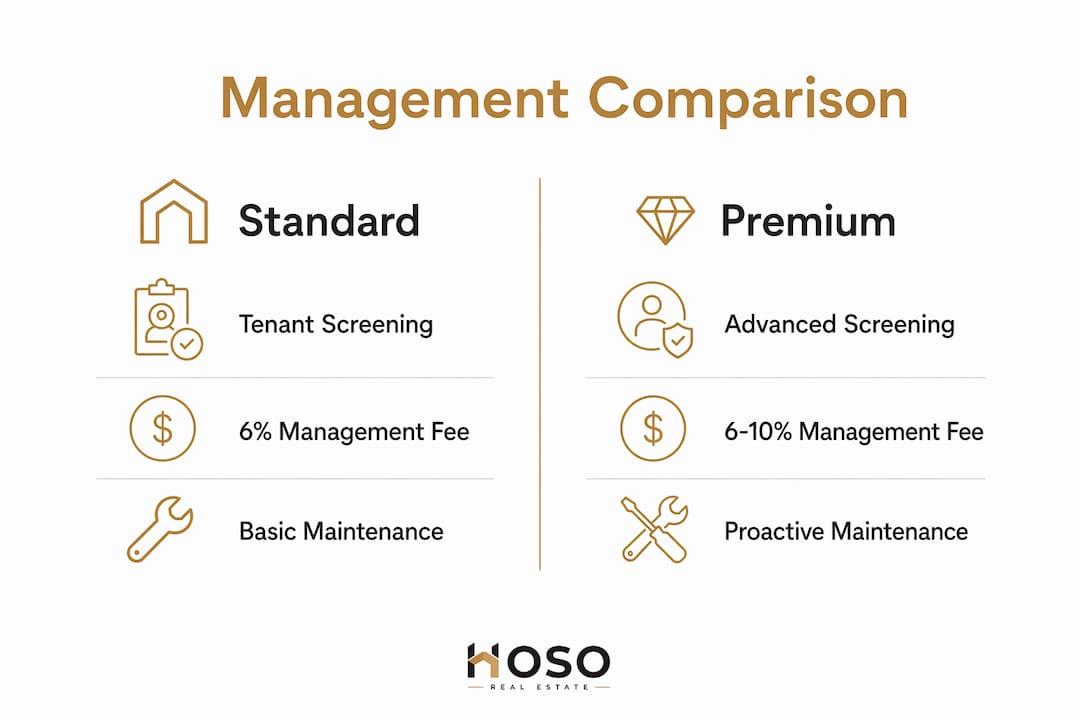
Standard management typically covers rent collection, basic maintenance coordination, and routine inspections. Premium management builds a complete operational framework around your property. The difference is not cosmetic. Higher-touch operations drive better vacancy rates, tenant quality, and long-term asset condition compared to standard approaches that rely on nicer marketing or higher asking rents alone.
The key features that define a premium property service include:
- Advanced tenant screening. Professional background vetting goes beyond basic income checks to include employment verification, financial stability assessment, rental history, and professional references. This reduces the risk of placing a tenant who looks good on paper but creates costly problems.
- Proactive maintenance programmes. Rather than waiting for things to break, premium managers schedule preventative inspections and seasonal checks to catch issues before they become expensive repairs. This protects the physical condition of the asset over time.
- Vetted vendor networks. Premium management uses established relationships with qualified tradespeople who understand the standard required for high-value properties. A standard handyman is not the right fit for a property with premium finishes.
- Dedicated communication. Dedicated managers with faster response times and proactive reporting are a defining feature. You are not waiting days for a reply or dealing with a rotating roster of staff who do not know your property.
- Targeted marketing. Premium rental properties require precision marketing directed at qualified, high-income tenant pools rather than broad-reach advertising that attracts unqualified enquiries.
Pro Tip: When evaluating a property management agency, ask specifically how they screen tenants beyond income verification. The depth of their answer tells you a great deal about whether they operate at a premium level.
How does premium management affect your financial returns?
The financial case for premium property management is grounded in vacancy reduction and asset preservation, not just the quality of service delivery. A high-value rental vacant even briefly incurs substantial income loss, and a property at $700 per week loses over $3,600 for every month it sits empty. Premium management reduces that risk through faster, more targeted tenant placement.
Premium management fees typically range from 6% to 10% of monthly rent, compared to standard residential management which often sits between 7% and 8% at the lower end. The fee difference is real, but the comparison needs to account for what you receive in return. A property that achieves consistent occupancy, retains quality tenants for longer, and avoids costly reactive maintenance will outperform one managed cheaply over a three to five year horizon.
| Factor | Standard management | Premium management |
|---|---|---|
| Tenant screening depth | Income and ID check | Financial, professional, and reference vetting |
| Maintenance approach | Reactive | Scheduled and preventative |
| Communication | Shared team, variable response | Dedicated manager, proactive updates |
| Vacancy management | Broad advertising | Targeted placement to qualified tenants |
| Fee range | 7%–8% of rent | 6%–10% of rent (higher service tier) |
The cost-benefit calculation also includes the condition of your asset at the end of each tenancy. Preventative maintenance and quality tenant selection reduce the likelihood of significant end-of-lease rectification costs. For investors comparing self-managing versus professional management, the financial gap widens considerably when you factor in time, compliance exposure, and the cost of getting tenant selection wrong.
What properties and tenants suit premium management?
Premium property management is the right fit for properties that carry higher financial risk if mismanaged. This includes properties with premium finishes, high weekly rents, executive appeal, or significant replacement costs for fixtures and fittings. In Adelaide, suburbs such as Unley, Burnside, Norwood, Medindie, and Glenelg consistently attract tenants who expect a professional, responsive management experience. A property in these areas managed to a standard level creates a mismatch between tenant expectations and service delivery.
Premium rental properties attract a smaller but more selective tenant pool who hold higher expectations for quality and responsiveness. These tenants are typically executives, medical professionals, senior government employees, or high-income earners relocating for work. They will not tolerate slow maintenance responses, poor communication, or a property that is not presented to a high standard. Losing a quality tenant from this pool due to poor management is a costly outcome that is entirely avoidable.
Consider the following criteria when assessing whether your property warrants premium management:
- The weekly rent is at or above the top quartile for the suburb.
- The property features high-end finishes, appliances, or fixtures that require specialist maintenance.
- The target tenant profile is a professional or executive with elevated service expectations.
- The property is in a high-demand Adelaide suburb where vacancy periods carry significant financial consequences.
- You are an interstate or overseas investor who cannot personally oversee the property.
Pro Tip: A premium rental appraisal process should assess not just the achievable rent but the target tenant profile, comparable leasing timeframes, and the presentation investment required to attract and retain quality tenants. If your appraisal does not cover these points, it is not a premium appraisal.
How does premium management align with SA tenancy law?
South Australian tenancy law creates specific obligations for landlords that carry real financial and legal consequences if mishandled. The Residential Tenancies Act 1995 (SA) governs most residential tenancy arrangements, and the South Australian Civil and Administrative Tribunal (SACAT) handles disputes, bond claims, and breach proceedings. Premium property management integrates these requirements into day-to-day operations rather than treating compliance as an afterthought.
Expert management integrates local tenancy laws, SACAT processes, and compliance best practices to reduce landlord exposure at every stage of the tenancy. This matters most when things go wrong. A poorly documented breach notice, an incorrectly lodged bond, or a missed inspection record can undermine a landlord's position in a SACAT hearing. Premium managers maintain the documentation standards that protect you.
Key compliance areas where premium management adds direct value include:
- Bond management. Correct lodgement with Consumer and Business Services (CBS) and accurate condition reporting at entry and exit.
- Breach notices. Correctly issued Form 2 or Form 3 notices with appropriate timeframes and documented evidence.
- Routine inspections. Conducted within the frequency limits set by SA law, with written reports retained for the tenancy record.
- Maintenance obligations. Timely response to urgent repairs as defined under SA tenancy legislation, with records of all communications and works completed.
- Tribunal preparation. Organised documentation and professional representation or support if a matter proceeds to SACAT.
The Adelaide rental market in 2026 continues to see tight vacancy rates and strong demand across inner and middle ring suburbs. This creates conditions where tenant selection decisions carry more weight, and where landlords who manage compliance well are better positioned to act decisively when tenancy issues arise.
Key takeaways
Premium property management delivers measurably better financial and operational outcomes for high-value rental properties through advanced tenant screening, proactive maintenance, and full compliance management.
| Point | Details |
|---|---|
| Defined service model | Premium management is a structured, high-touch approach distinct from standard residential management. |
| Financial justification | Fees of 6%–10% are offset by lower vacancy, better tenant retention, and reduced repair costs. |
| Tenant and property fit | Best suited to high-rent properties in suburbs like Unley, Burnside, and Norwood with professional tenant profiles. |
| SA compliance integration | Premium managers handle SACAT processes, bond lodgement, and breach documentation to protect landlords. |
| Proactive over reactive | Scheduled maintenance and preventative inspections protect asset condition and reduce long-term costs. |
What I have observed managing premium properties in Adelaide
The most consistent mistake I see landlords make is applying a standard management framework to a property that demands more. The assumption is that a higher rent will attract a better tenant regardless of how the property is managed. That is not how it works. A premium property presented without professional marketing, managed without a dedicated contact, and maintained reactively will underperform. The tenant it attracts will not be the tenant it deserves.
One-size-fits-all management rarely works for high-end assets. What I have found in practice is that the landlords who get the best long-term results are the ones who treat management as a strategic function, not an administrative cost. They ask the right questions before signing a management agreement. They want to know about vendor relationships, inspection frequency, communication protocols, and how disputes are handled. Those questions separate informed investors from ones who are simply hoping for the best.
The Adelaide premium rental market has its own character. Tenants in Medindie or Burnside are not the same as tenants in the outer suburbs, and the management approach needs to reflect that. Personalised service, as discussed in luxury property management contexts, consistently produces better outcomes than volume-based management models. The landlords who understand this tend to hold better-performing portfolios over time.
— HOSO
Manage your Adelaide property with HOSO Real Estate
HOSO Real Estate specialises in premium property management for Adelaide landlords and investors who expect more from their management agency. Our approach covers advanced tenant screening, proactive maintenance coordination, full SA tenancy compliance, and dedicated communication at every stage of the tenancy.
If you own a high-value rental property in suburbs like Unley, Norwood, Burnside, or Glenelg, and you want management that protects your asset and performs consistently, HOSO Real Estate is built for that. Explore our property management services or visit HOSO Real Estate to learn how we manage Adelaide's premium rental properties.
FAQ
What is premium property management?
Premium property management is a high-touch service model that applies advanced tenant screening, proactive maintenance, dedicated communication, and full compliance management to high-value rental properties. It differs from standard management by treating the property as a long-term investment asset rather than a basic tenancy arrangement.
What does a premium rental appraisal process include?
A premium rental appraisal process assesses the achievable rent, target tenant profile, comparable leasing timeframes, and the presentation standard required to attract qualified tenants. It goes beyond a basic market rent estimate to inform a complete leasing strategy.
How much does premium property management cost in Australia?
Premium property management fees typically range from 6% to 10% of monthly rent. The higher fee reflects the depth of service, including dedicated managers, vetted vendor networks, and proactive maintenance programmes that reduce vacancy and protect asset condition.
Which Adelaide suburbs benefit most from premium management?
Properties in Unley, Burnside, Norwood, Medindie, and Glenelg consistently attract professional and executive tenants who expect premium service standards. These suburbs carry higher financial risk if mismanaged, making premium management the appropriate service level.
How does premium property management protect landlords under SA law?
Premium management integrates SA tenancy compliance into daily operations, covering correct bond lodgement with Consumer and Business Services, properly issued breach notices, routine inspection records, and SACAT preparation. This documentation discipline protects landlords if a tenancy dispute proceeds to tribunal.