

That headline masks big variation: outer northern and western suburbs push past 5.5% gross, while inner blue-chip pockets trade yield for capital growth. If you're chasing cashflow, look at Beverley, Woodville, Croydon and Munno Para first, then check the suburb table and underwriting checklist below before you make an offer.
TL;DR:
- Outer northern and western suburbs like Beverley, Woodville, Croydon, and Munno Para offer gross house yields of 5% to 6% for strong cash flow.
- Strata fees significantly affect net yields on units, often reducing gross yield figures by over 2 percentage points depending on levies.
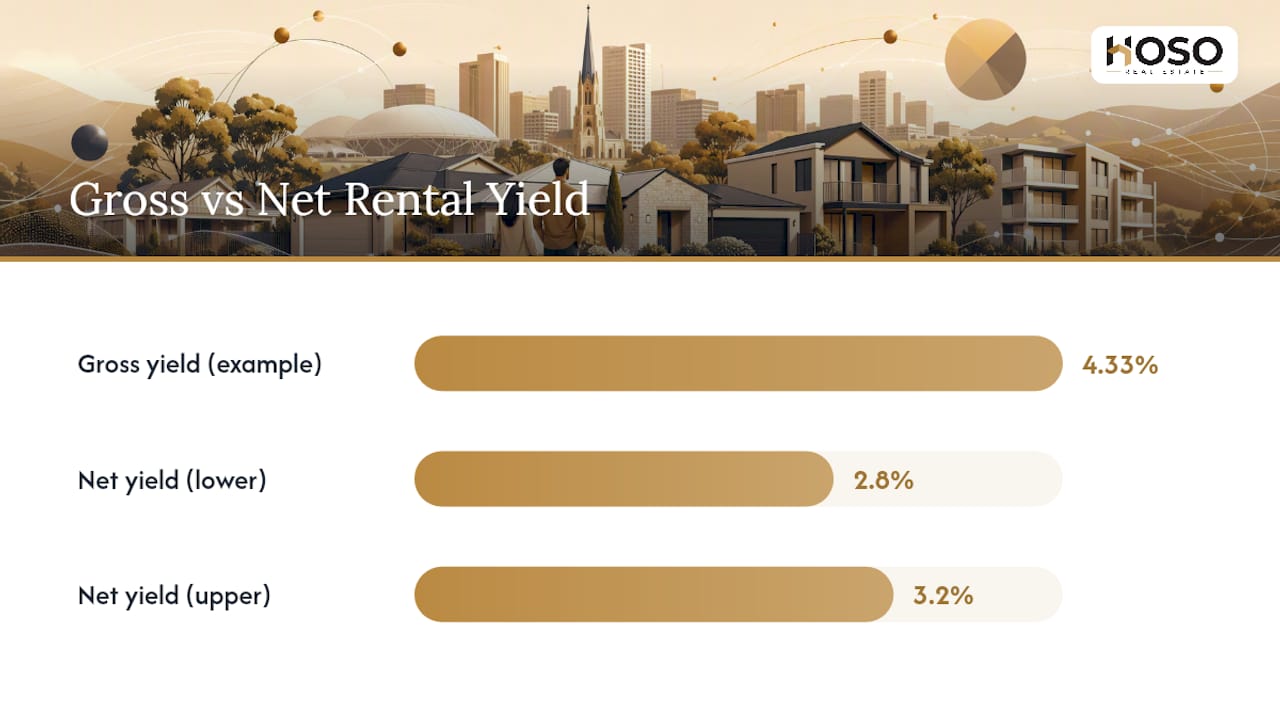
- A typical house purchase for $600,000 renting at $500 weekly yields around 4.33% gross, with net yields between 2.8% and 3.2% after expenses.
- Model a vacancy period of four to six weeks and review last two levies to accurately estimate a property's net yield before committing.
- Well-managed properties in suburbs with high tenant demand can outperform poorly managed inner-city assets on yield, regardless of location.
Table of Contents
- What are Adelaide's current rental yields?
- Which Adelaide suburbs deliver the highest rental yields?
- How do you calculate gross and net rental yield?
- How do you underwrite an Adelaide rental yield before you buy?
- HOSO's view on protecting yield after settlement
- What actually moves the needle on Adelaide rental yield
- How HOSO Real Estate helps you turn suburb data into rental income
- Sources
What are Adelaide's current rental yields?
Units tell a different story: a median price of $650,000 paired with $550 weekly rent produces a gross yield closer to 4.7%, a gap that has held for most of the past year as unit prices have lagged house price growth.
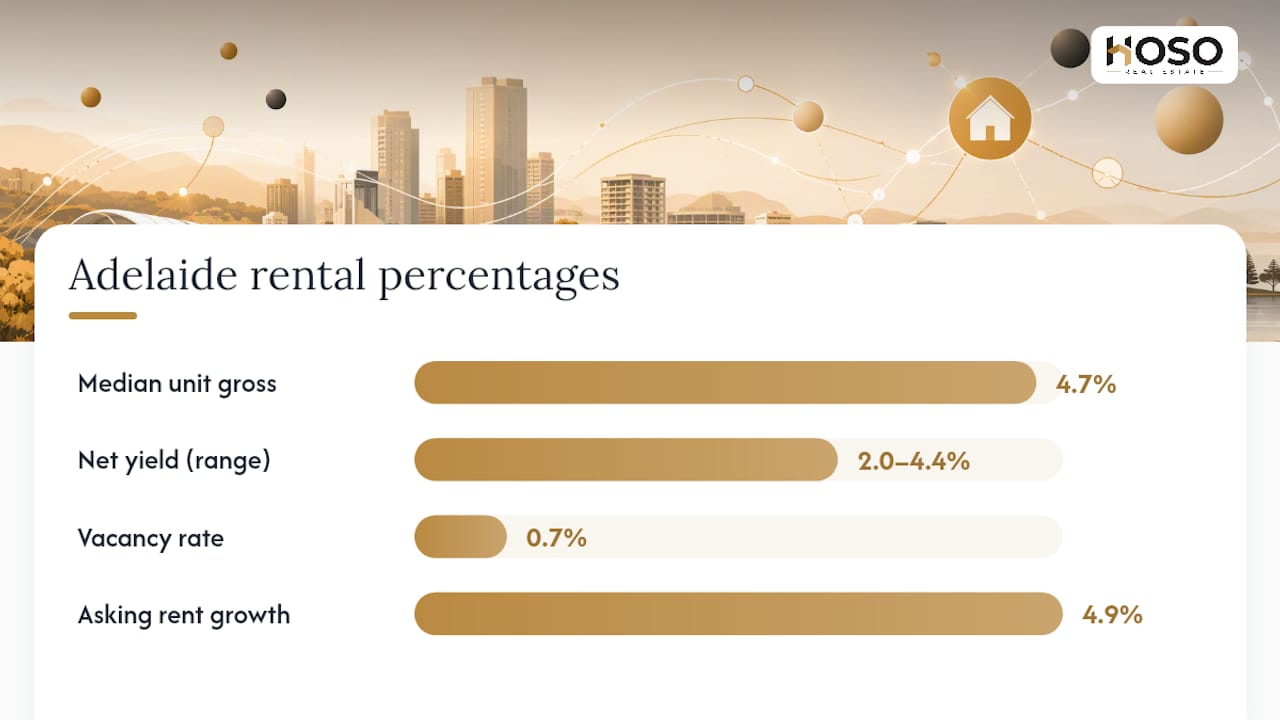
Net yield is the number that actually matters once you've paid for the privilege of owning the asset. After management, strata (where applicable), council rates, insurance, maintenance and a realistic allowance for vacant weeks, net yields in Adelaide typically land between 2.0% and 4.4%, depending on property type. Units often start with the higher gross figure but lose more of it to body corporate levies, so the gap between gross and net narrows or sometimes reverses.
Three numbers worth pinning to your investment brief:
- Adelaide's vacancy rate sits near 0.7%, among the tightest of any Australian capital, which limits letting risk but also caps how fast rents can climb.
- Asking rents have grown around 4.9% year-on-year, a moderate pace compared with the sharper spikes seen in Perth and Brisbane.
- Strata fees are consistently flagged as the single biggest swing factor separating gross yield from net yield on Adelaide units.
Statistic to watch: a 1.0 percentage point gap between gross and net yield is common on a well-run house; on a unit with heavy body corporate obligations, that gap can stretch past 2.0 points. Always ask for the last two levy notices before you model a unit's numbers.
Which Adelaide suburbs deliver the highest rental yields?
Two tiers are worth separating when you're building a shortlist: suburbs that lead purely on cash yield, and suburbs that balance yield with a credible growth story.
Tier 1: affordability-driven yield leaders. Beverley, Woodville, Croydon and Munno Para consistently post gross house yields in the 5% to 6% band. These suburbs share a common thread: lower entry prices relative to rent, a steady blue-collar and family tenant pool, and proximity to employment corridors along the northern and western rail and arterial routes. They won't win any beauty contests for capital growth forecasts, but the tenant demand is dependable.
Tier 2: balanced yield and growth plays. Mawson Lakes, Port Adelaide and Tonsley sit closer to the CBD and major employment or education precincts, and this is where units frequently outperform houses on yield. Modelling on a one-bedroom Adelaide CBD apartment purchased around $435,000 with rent near $2,350 a month produces a gross yield up to 6.5%, among the strongest figures in the metro area, supported by a deep pool of students, health workers and young professionals who need a bed near the CBD, not a backyard.
Treat these bands as a starting point, not gospel. Suburb medians move month to month, and yield modelling from early to mid 2026 can shift once new listing data lands. Before you act on any of these figures, check a current listing-level yield estimate through a platform like PropRadar and run your own numbers on the specific property, not the suburb average.
How do you calculate gross and net rental yield?
Gross yield is the easy part: divide annual rent by purchase price, multiply by 100. A house bought for $600,000 renting at $500 a week ($26,000 a year) delivers a gross yield of 4.33%.
Net yield is where the real decision gets made. Take that same $26,000 in annual rent and strip out the costs of actually running the property:
- Subtract routine maintenance and an allowance for periodic capital works.
- Subtract council rates, water supply charges and landlord insurance.
- Subtract strata or body corporate levies if it's a unit or townhouse.
- Subtract land tax exposure, particularly relevant for investors holding multiple SA properties.
- Build in a vacancy allowance rather than assuming 52 weeks of rent every year.
Run those deductions and a 4.33% gross yield can easily settle into a 2.8% to 3.2% net figure. Mortgage interest is deliberately excluded from this calculation. Yield is a property-level metric, not a personal financing metric, and blending the two hides how the asset itself performs.
Pro Tip: *Before you trust an agent's advertised rent, pull three comparable current listings in the same suburb and bedroom count.
How do you underwrite an Adelaide rental yield before you buy?
Suburb-level yield data tells you where to look. It doesn't tell you whether a specific property will perform. Before you commit, work through this checklist against the actual listing:
- Confirm the realistic achievable rent using current comparable lettings, not the agent's optimistic figure.
- Model a vacancy buffer of at least four to six weeks even in a tight market, since tenant turnover and re-letting time still eat into annual returns.
- Request the last two body corporate levy notices on any unit or townhouse, given how much strata costs can distort net yield.
- Check your land tax exposure, especially if this purchase adds to an existing SA portfolio, since aggregated landholdings shift the tax threshold you sit under.
- Factor in a slightly larger maintenance and capex allowance on older outer-suburb stock, where build quality and history vary more than in newer inner-fringe developments.
Weigh the trade-off honestly. Outer-ring suburbs like Munno Para or Beverley hand you stronger day-one cashflow but a less certain long-term capital growth trajectory. Inner-fringe suburbs like Mawson Lakes or Port Adelaide often ask you to accept a slightly lower net yield in exchange for a tenant pool and growth story that ages better over a ten-year hold.
Bedroom count matters more than most first-time investors expect. One and two bedroom units consistently outperform three-bedroom houses on yield in Adelaide, largely because smaller footprints attract a bigger renter pool relative to purchase price. If your goal is cashflow, a well-located two-bedder usually beats a family house on the numbers, even if the house feels like the safer, more familiar buy.
Once the numbers stack up on paper, the next steps are practical: get a current local rental appraisal, book a physical inspection rather than relying on photos, and model a conservative twelve-month cashflow that assumes at least one vacancy period.
HOSO's view on protecting yield after settlement
Buying the right suburb only gets you halfway. HOSO Real Estate manages portfolios across Adelaide's northern, western and inner-fringe suburbs, and the pattern is consistent: two properties with near-identical advertised yields can produce very different net returns depending on who's managing the tenancy.
A few habits protect that yield in practice, not just on a spreadsheet:
- Thorough tenant screening reduces the risk of arrears and costly turnover between leases.
- A proactive maintenance cadence catches small issues before they become expensive capital works.
- Regular routine inspections, properly documented, support compliance and reduce dispute risk if a matter ever reaches SACAT.
Tenant demand also varies meaningfully by suburb type. CBD and Mawson Lakes units draw students and health professionals who prioritise proximity and turnover reliability. Outer northern and western suburbs like Munno Para and Woodville attract longer-term family tenants who value stability, and that translates into lower turnover costs even where the headline yield looks similar on paper.
What actually moves the needle on Adelaide rental yield
The suburb league tables get most of the attention, but they're the easy part of this exercise. Anyone can rank a list of postcodes by gross yield. The harder, more valuable work is what happens after settlement, and that's where most first-time Adelaide investors underperform their own spreadsheet.
The conventional advice, "buy for yield in the outer suburbs, buy for growth near the CBD," is directionally correct but dangerously simplistic. It ignores that a high-yield outer suburb with a poorly screened tenant and a deferred maintenance backlog can underperform a lower-yield inner suburb managed well. Yield on paper and yield in your bank account are two different numbers, and the gap between them is almost entirely determined by property management quality, not suburb selection.
If there's one thing worth prioritising above suburb research, it's this: model your numbers conservatively before you buy, then manage the asset as rigorously as you researched it. Adelaide's tight vacancy rate is a genuine tailwind right now, but tailwinds don't compensate for a poorly managed tenancy.
— HOSO
How HOSO Real Estate helps you turn suburb data into rental income
Suburb tables and yield calculators only get you so far. HOSO Real Estate's property management services cover the parts of the equation that actually protect your net return: rental appraisals grounded in current comparable lettings, tenant leasing and screening, routine inspections, maintenance coordination and SA compliance management, all handled with the transparency you'd expect from a boutique agency built around portfolio stewardship rather than volume.
If you're weighing up a purchase in Beverley, Mawson Lakes or anywhere else on this list, a free rental appraisal gives you a realistic rent figure to underwrite against, rather than an agent's optimistic guess. You can also browse recently leased properties to see genuine letting outcomes across Adelaide before you commit. Get in touch with HOSO Real Estate for a portfolio review and a straight answer on what your next Adelaide purchase could realistically earn.
Sources
- Top South Australia suburbs by rental yield
- Adelaide investment property 2026: best suburbs, yields & the post‑boom outlook
- What is a good rental yield and how do you calculate it? | Aussie