

Comparing property management quotes means evaluating total annual costs, service scope, and quality indicators across multiple agencies before signing a management agreement. The headline management fee percentage is only one part of the picture. Once you add letting fees, advertising, inspections, lease renewals, maintenance markups, and GST, the true all-in cost can be nearly double the advertised rate. For South Australian landlords and investors, understanding how to read and compare property management service quotes is the difference between protecting your asset and quietly eroding your returns.
What fees should you expect in Australian property management quotes?
Australian property management agencies charge management fees ranging from 5% to 15% of gross weekly rent, with significant variation by state and location type. South Australia sits at the higher end nationally, with fees typically between 8% and 15% in Adelaide and metro areas. NSW agencies generally charge 5% to 8%, while Victoria ranges from 5% to 10% and Queensland from 7% to 12%. These figures reflect base management only and do not include the additional charges that accumulate over a tenancy.
The additional charges are where property management cost comparisons get complicated. Letting fees of 1 to 2 weeks rent, advertising costs of $300 to $600, routine inspection fees of $80 to $150 per visit, and lease renewal fees of $150 to $350 are all standard line items in most agency fee schedules. Each of these is charged separately and attracts GST on top. An 8.5% management fee effectively costs 9.35% once GST is applied, a detail many landlords overlook when comparing quotes side by side.

Maintenance markups are another cost that rarely appears in headline comparisons. Agencies commonly add 5% to 15% on trades invoices, meaning a $2,000 annual repair bill could carry an additional $200 to $300 in agency margin. This is not inherently unreasonable, but it must be disclosed and factored into your comparison.
The table below shows typical fee ranges across key states for a standard residential property.
| Fee type | SA | NSW | VIC | QLD |
|---|---|---|---|---|
| Management fee | 8%–15% | 5%–8% | 5%–10% | 7%–12% |
| Letting fee | 1–2 weeks rent | 1–2 weeks rent | 1 week rent | 1–2 weeks rent |
| Routine inspection | $80–$150 | $80–$120 | $80–$110 | $80–$130 |
| Lease renewal | $150–$350 | $100–$250 | $100–$200 | $100–$300 |
| Advertising | $200–$500 | $200–$600 | $150–$400 | $200–$500 |
How do you compare property management quotes effectively?
Effective property management quote comparison requires a structured process, not a quick scan of percentage rates. Follow these steps to evaluate quotes with the rigour your investment deserves.
-
Request a full written fee schedule from every agency. This is a legal requirement in NSW and best practice everywhere in Australia. The schedule must itemise the management percentage, letting fees, inspection charges, advertising costs, lease renewal fees, tribunal representation fees, and GST treatment for each item. Any agency that cannot or will not provide this in writing is a red flag.
-
Calculate the all-in annual cost using a realistic tenancy scenario. Take a property renting at $500 per week in Adelaide. At a 10% management fee, the base annual cost is $2,600. Add one letting fee of $1,100 (two weeks rent plus GST), four routine inspections at $110 each, one lease renewal at $250, and advertising at $350. The total reaches approximately $4,740 before maintenance markups. That represents a true annual cost closer to 18% of gross rent. This calculation method, applied consistently across all quotes, gives you a genuine property management cost comparison.
-
Assess service quality indicators alongside fees. Maintenance response times are a concrete quality measure: critical repairs should be attended within one hour, routine repairs within 48 hours. Ask each agency what dollar threshold triggers owner approval for repairs. Agencies with a $500 threshold give you more control than those with a $1,000 limit.
-
Ask directly about hidden fees. Specific questions to ask include: Do you charge a fee for SACAT appearances? Is there a fee for issuing breach notices? Do you mark up maintenance invoices, and if so, at what percentage? Do you charge for end-of-financial-year statements?
-
Compare contract terms and exit conditions. A 30-day exit clause with no penalty is standard for a well-run agency. Lengthy lock-in periods or high exit fees suggest the agency relies on retention by contract rather than service quality.
Pro Tip: Ask each agency to model your expected annual management cost based on your property's specific rent, typical tenancy length, and maintenance history. Agencies that engage with this request demonstrate transparency. Those that deflect or only quote the headline rate are telling you something important.
What mistakes should you avoid when comparing quotes?
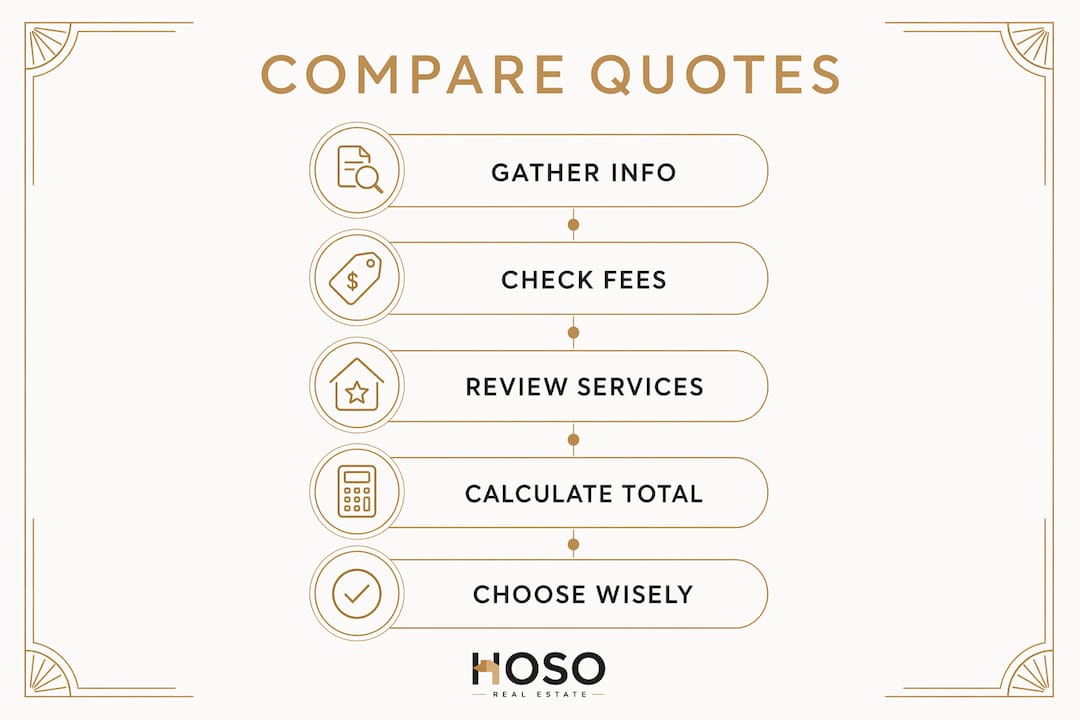
The most common error landlords make is treating the headline management fee as the primary comparison point. A 7% fee from one agency and a 10% fee from another tells you almost nothing about which will cost less or perform better over a 12-month period. The true annual cost in a Melbourne example showed a 5.8% headline fee translating to 13.9% once all extras were included. The same dynamic applies in Adelaide.
Watch for these specific traps when you evaluate property management costs:
- Ignoring GST on every line item. Every fee charged by a property management agency attracts GST. A quote that lists fees exclusive of GST will cost 10% more than it appears. Always confirm whether quoted fees are GST-inclusive or exclusive.
- Overlooking vacancy loss. A week of vacancy costs more than a month of management fees on most properties. Ask each agency for their average days-to-lease metric and their vacancy rate across their portfolio. An agency charging 9% that leases properties in 14 days outperforms one charging 7% that averages 28 days vacant.
- Failing to clarify maintenance markup rates. Agencies that do not disclose their markup policy upfront may be applying 15% or more to every trades invoice. Require written disclosure of the markup rate and a process for obtaining multiple quotes on larger repairs.
- Neglecting compliance responsibilities. Landlords remain legally responsible for compliance with tenancy laws even when a property manager is appointed. Confirm that the agency has written procedures for smoke alarm compliance, pool safety, and minimum housing standards. Gaps in compliance management create direct financial and legal risk for you as the owner.
- Accepting verbal assurances. Any commitment about fees, response times, or processes that is not in the management agreement or fee schedule has no enforceable weight. If an agency promises something verbally, ask for it in writing before signing.
Pro Tip: Request a copy of the agency's management agreement before committing. Read the clauses on fee variation, maintenance authorisation limits, and termination conditions. A well-drafted agreement protects both parties and signals a professional operation.
How do property management fees and services vary in South Australia?
South Australian landlords operate in a market where management fees of 8% to 15% are standard, placing SA at the higher end of the national range. This reflects the relatively smaller scale of the Adelaide market compared with Sydney or Melbourne, where portfolio sizes allow agencies to operate on thinner margins. In inner Adelaide suburbs such as Norwood, Unley, and Prospect, fees tend to sit at the lower end of the SA range due to higher rental demand and lower vacancy risk. In outer metro and regional areas, fees are typically higher.
SA legislation requires that agency agreements clearly disclose all fees and charges before a management agreement is signed. This aligns with the written fee schedule requirement that applies nationally as best practice. SACAT, the South Australian Civil and Administrative Tribunal, handles residential tenancy disputes in SA. Confirm that any agency you appoint has direct experience with SACAT processes and charges a disclosed fee for tribunal representation rather than billing it as an unspecified extra.
The table below provides SA-specific cost benchmarks compared with national averages for a property renting at $500 per week.
| Cost item | SA typical | National average |
|---|---|---|
| Annual management fee | $2,080–$3,900 | $1,820–$2,860 |
| Letting fee (one tenancy) | $1,100–$1,210 | $900–$1,100 |
| Four routine inspections | $352–$660 | $320–$480 |
| Lease renewal | $165–$385 | $110–$330 |
| Advertising | $220–$550 | $165–$550 |
For SA landlords, licence verification of any agency is a non-negotiable first step before requesting quotes. Consumer and Business Services South Australia maintains the public register of licensed agents. An unlicensed operator has no legal authority to manage your property and creates significant liability exposure.
Key takeaways
Comparing property management quotes requires calculating total annual costs across all fee components, not just the headline management rate.
| Point | Details |
|---|---|
| Total cost, not headline rate | Calculate all fees, GST, and markups annually to find the true management cost. |
| SA fees sit higher nationally | Adelaide landlords should expect 8%–15% base rates plus additional charges on top. |
| Written fee schedules are non-negotiable | Request itemised schedules from every agency before making any comparison. |
| Service quality affects net returns | Vacancy rates, maintenance response times, and tenant screening directly impact your bottom line. |
| Compliance is your responsibility | Confirm written compliance procedures with any agency, as legal obligations remain with the owner. |
What I've learned from watching landlords compare quotes the wrong way
Most landlords who come to us have already made one of two mistakes. They either chose the cheapest headline rate without modelling total costs, or they chose a large agency assuming scale equals quality. Neither assumption holds up in practice.
The landlords who get the best outcomes from their property management comparison are the ones who treat it like a procurement exercise. They request written fee schedules, they run the numbers on a realistic 12-month scenario, and they ask hard questions about maintenance markups and vacancy management. They also weigh service quality against cost, recognising that a slightly higher fee from an agency with strong tenant retention and fast maintenance response can produce a better net return than a cheaper agency with higher vacancy and turnover.
Transparency is the clearest signal of a well-run agency. An agency that publishes its fee schedule, explains its maintenance approval process, and provides written compliance procedures has nothing to hide. One that deflects specific questions or only quotes a percentage is asking you to trust a number without context.
In South Australia specifically, the regulatory environment around tenancy compliance is tightening. Landlords who appoint agencies without written compliance procedures are taking on risk that a slightly lower management fee will never compensate for. The cost of a SACAT dispute, a compliance breach, or a poorly screened tenant far exceeds the annual saving from choosing a cheaper agency.
— HOSO
Get a transparent quote from HOSO Real Estate
HOSO Real Estate provides Adelaide landlords and investors with clear, itemised fee schedules and no hidden charges. Every quote includes a full breakdown of management fees, letting fees, inspection costs, and maintenance policies so you can make a genuine property management cost comparison from the outset.
HOSO specialises in residential property management across Adelaide and metropolitan South Australia, with direct experience in SACAT processes, compliance management, and tenant leasing. If you are ready to compare rental management services with a local agency that prioritises your asset performance, visit our services page to request a consultation or fee schedule tailored to your property.
FAQ
What is included in a property management quote?
A property management quote should include the ongoing management fee percentage, letting fee, advertising costs, routine inspection fees, lease renewal fees, maintenance markup rate, and GST treatment for each charge. Any quote that only states a management percentage is incomplete.
What is a reasonable management fee in South Australia?
SA management fees typically range from 8% to 15% of gross weekly rent, which sits above the national average. Inner Adelaide suburbs tend to attract fees at the lower end of this range due to higher rental demand.
How do I calculate the true cost of property management?
Add the annual management fee, one letting fee, all routine inspection fees, lease renewal fees, advertising costs, and estimated maintenance markups, then apply GST to each item. This total, divided by annual gross rent, gives you the true management cost percentage.
What questions should I ask when comparing property managers?
Ask each agency for their written fee schedule, maintenance markup rate, repair approval threshold, average days-to-lease, vacancy rate across their portfolio, SACAT experience, and exit clause terms. Answers to these questions reveal far more than the headline fee.
Do property management fees include GST in Australia?
GST is applied on top of all property management fees and additional charges. An 8.5% management fee costs 9.35% once GST is included. Always confirm whether quoted fees are GST-inclusive or exclusive before comparing figures across agencies.