
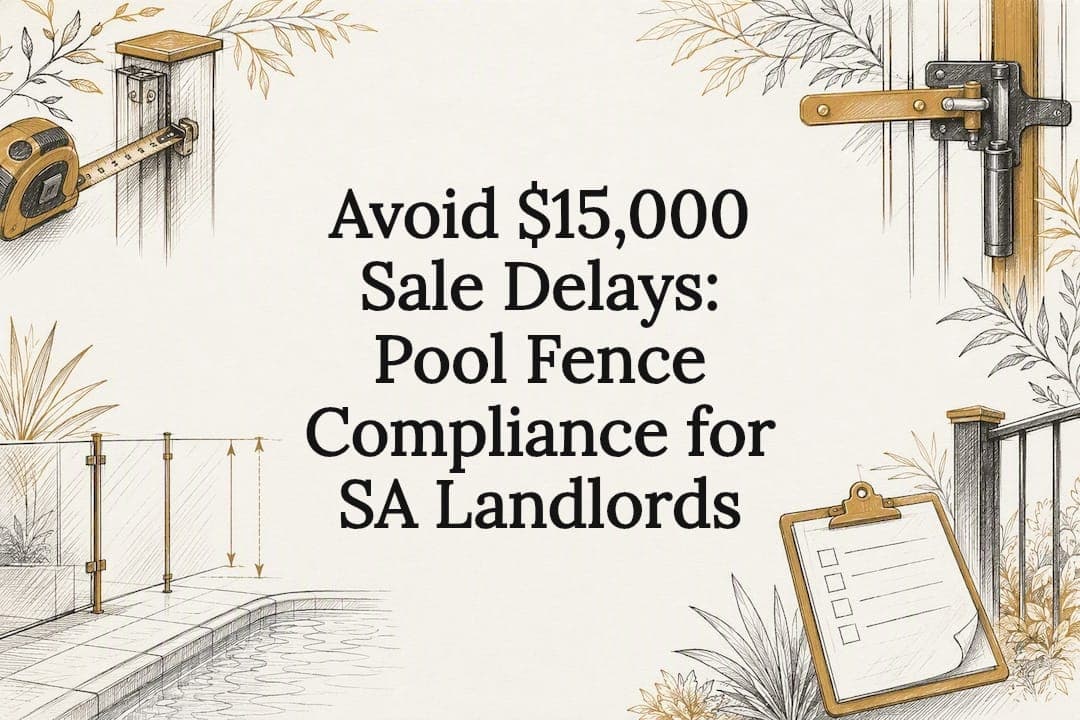
In South Australia, any pool or spa holding 300 mm or more of water needs a continuous, compliant child safety barrier, and the owner carries legal responsibility for keeping it that way. There's no exemption for age, size, or whether the pool is permanent or portable. Selling the property triggers its own upgrade obligations, with penalties reaching $15,000 for non-compliance. The technical detail sits in Australian Standard AS 1926 and your local council, but the principle is simple: if it holds water past that threshold, it needs a barrier that works every single day.
TL;DR:
- Pool barriers must be at least 1.2 meters high, with boundary fences reaching 1.8 meters and a 900 mm non-climbable zone, to meet compliance standards.
- Gates require self-closing, self-latching mechanisms positioned at least 1.5 meters above ground, and must swing outward to prevent accidental opening.
- Inspection and notification procedures for new pools and sales are strict, with council inspections within set timeframes and penalties of up to $15,000 for non-compliance.
- Portable and inflatable pools holding 300 mm or more of water are subject to the same fencing requirements as in-ground pools, regardless of whether they are temporary.
- Ongoing maintenance, including monthly gate checks and clearing the non-climbable zone, is essential for compliance and safety, with certified inspections recommended before sale or if issues arise.
Table of Contents
- What counts as pool fence compliance South Australia requires?
- When do council inspections and notifications apply?
- What happens at sale: upgrades, older pools and penalties
- Do portable pools and spas need fencing too?
- What are your ongoing responsibilities as the pool owner?
- What exactly is the non-climbable zone, and how is it measured?
- What materials and construction standards apply to pool fences?
- Are glass pool fences held to different rules in South Australia?
- Who inspects pool fences, and what do they check?
- How do you get a compliance certificate or official approval?
- What happens if you ignore a non-compliant pool fence?
- HOSO's view: why compliance protects more than the pool
- Sources
What counts as pool fence compliance South Australia requires?
Pool fence compliance South Australia requirements come down to measurements, not opinions. A compliant barrier must be at least 1.2 metres high, and if you're using an existing boundary fence as part of that barrier, the pool side needs to reach 1.8 metres with a 900 mm non-climbable zone (NCZ) at its base. These aren't rough guides. They're the figures a council inspector or private certifier will pull out a tape measure to check.
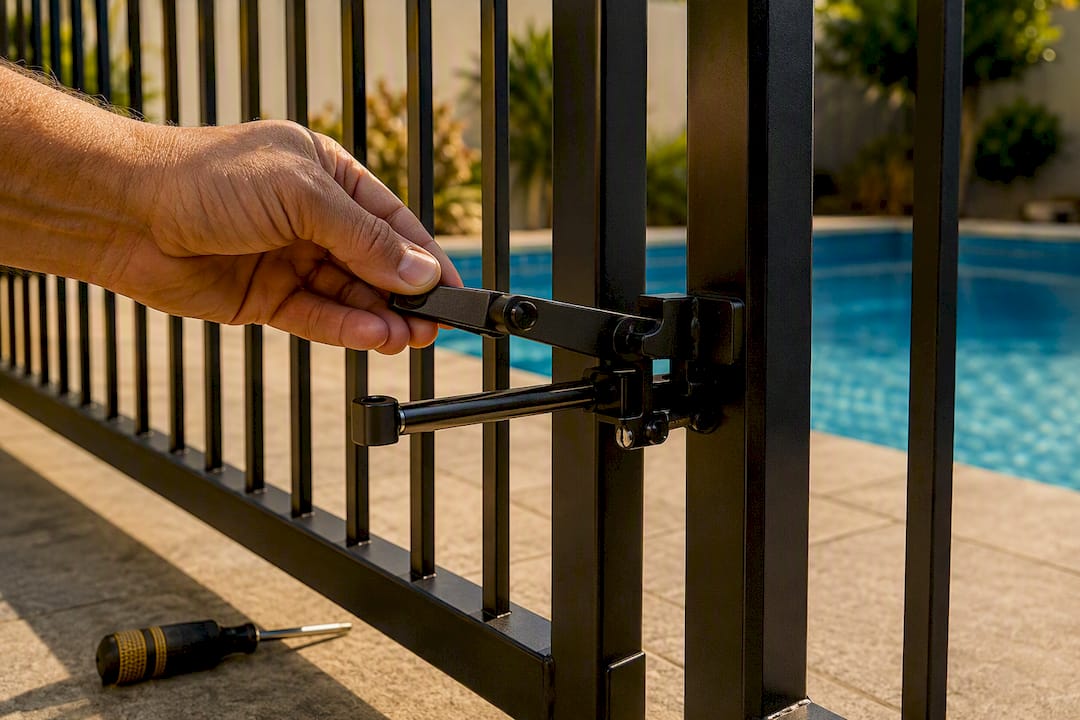
Gates are where most fences fail. A compliant gate must swing outward, away from the pool, and it needs to be self-closing and self-latching from any open position. The latch has to sit at least 1.5 metres above ground level, out of reach of a toddler standing on tiptoe or a chair someone left nearby. Test it yourself: open the gate fully, let go, and watch whether it swings shut and clicks the latch without help. If it drifts, sticks, or needs a shove, it's not compliant.
Common failure points include:
- Horizontal top rails on fences that a child can use as a foot hold to climb over.
- Garden furniture, pot plants, or wood piles placed within the non-climbable zone.
- Gaps in vertical pickets wider than 100 mm, which let small bodies slip through.
- Gates propped open with a brick or wedge during pool parties or maintenance.
- Overgrown shrubs against the fence line that create an accidental ladder.
Australian Standard AS 1926 parts 1 and 2 sets the technical detail behind these figures, covering fence spacing, gap tolerances, and gate hardware. South Australia adopts these standards alongside Ministerial Building Standard MBS 004 (also referenced as SA 76D), which councils use as the benchmark during inspections. For certain pool classes, SA G1P2 also requires visible CPR signage at the pool area, a small but easily overlooked requirement that inspectors do check.
Pro Tip: Get a spring-loaded gate closer tested annually, not just at installation. Hinges sag, springs weaken, and a gate that latched perfectly in 2023 can drift open by 2026 without anyone noticing until an inspector points it out.
When do council inspections and notifications apply?
New pool construction in South Australia comes with a notification chain that owners can't skip. Builders or owners must notify the local council once the pool and its safety barrier are complete, and councils must then inspect within mandated timeframes following that notification.
The process generally runs in this order:
- Pool construction finishes, including the permanent barrier and gate hardware.
- Owner or builder notifies council that the safety barrier is complete and ready for inspection.
- A temporary compliant barrier may be used, but only for up to two months, and the pool must not be filled with water until a proper barrier is in place.
- Council inspects the completed barrier against the regulation's requirements.
- Owner arranges any water-filling permits required through SA Water, once the barrier passes.
Skipping steps here is a common trap for owners managing their own pool build, particularly when a builder assumes someone else has made the call to council.
Pro Tip: Book a private certifier for a pre-inspection review before the official council visit. It costs you time upfront but catches defects, like an incorrectly hung gate or an NCZ obstruction, while they're cheap and easy to fix rather than after a failed inspection delays your pool's use.
What happens at sale: upgrades, older pools and penalties
Selling a property with a pool is a prescribed event under South Australian regulation, meaning the transfer of title itself triggers a legal requirement to have designated safety features installed and functioning before settlement. This catches out plenty of sellers who assume an old, "grandfathered" pool is exempt.
It isn't, for the most part. Here's how the timing rules actually work:
- Pools built before 1 July 1993 must be upgraded to meet current MBS 004 standards before the property can settle, regardless of how long the pool has existed.
- Pools approved after that date follow whichever safety rules were current at the time of their original approval, though most still need to demonstrate the barrier remains functional.
- Non-compliance at sale carries a maximum penalty of $15,000, and settlement can be delayed while remediation happens.
- Conveyancers increasingly expect a compliance report even though a formal certificate isn't strictly mandated by legislation, which means turning up without one can spook a buyer's solicitor.
The practical workflow that avoids drama: arrange a pool safety inspection the moment you list, get remediation quotes immediately if anything fails, and hand your conveyancer a private certifier's report well before contracts exchange. Waiting until a buyer's building inspector flags an issue is the expensive way to find out your fence has a problem.
Do portable pools and spas need fencing too?
Yes, and this is the rule most homeowners get wrong. Any portable, inflatable, or above-ground pool holding 300 mm or more of water needs the same compliant barrier as an in-ground pool. That kiddie pool from Bunnings isn't exempt just because it deflates and packs away each winter.
Key points for portable and spa setups:
- All portable pools sold in Australia must carry a warning label under consumer law, stating whether fencing requirements apply to that model.
- A boundary fence can serve as part of the barrier for a spa if it reaches 1.8 metres on the pool side with the full 900 mm non-climbable zone intact.
- Check pump and recirculation safety on spas separately. A running pump near an unfenced spa is its own hazard beyond the barrier question.
- CPR signage requirements can apply to spas in the same way they apply to full-sized pools, depending on the building class.
Consumer and Business Services SA notes that most drownings involving children under five in private pools are linked to barriers that didn't comply with legislation, which is exactly why the 300 mm threshold applies without exception to portable and inflatable pools left set up over a long Adelaide summer.
What are your ongoing responsibilities as the pool owner?
Compliance doesn't end once the fence passes inspection. Owners must keep the barrier and its immediate surrounds free of climbable hazards on an ongoing basis, not just on the day of the original approval.
A workable maintenance routine looks like this:
- Inspect the gate monthly, checking the self-close and self-latch action under normal use.
- Walk the non-climbable zone every season, removing pot plants, furniture, or garden waste that's crept into the 900 mm perimeter.
- Photograph and date your checks, building a simple record you can hand to a certifier or conveyancer later.
- Engage a private certifier every few years, or immediately before listing the property for sale.
- Brief tenants clearly if the property is leased, since a tenant propping a gate open for a pool party creates a compliance breach the owner still answers for.
Pro Tip: If you're an interstate or overseas investor who can't personally check a gate latch every month, that's precisely the gap a managed property service closes. Coordinating certifier visits, maintenance logs, and tenant communication around a pool barrier is exactly the kind of detail that gets missed when a property runs itself.
For landlords juggling multiple compliance obligations across a portfolio, our guide on Adelaide rental compliance requirements covers the broader landscape beyond just pool safety, and our piece on landlord obligations in South Australia sets out where tenant communication duties intersect with safety maintenance.
What exactly is the non-climbable zone, and how is it measured?
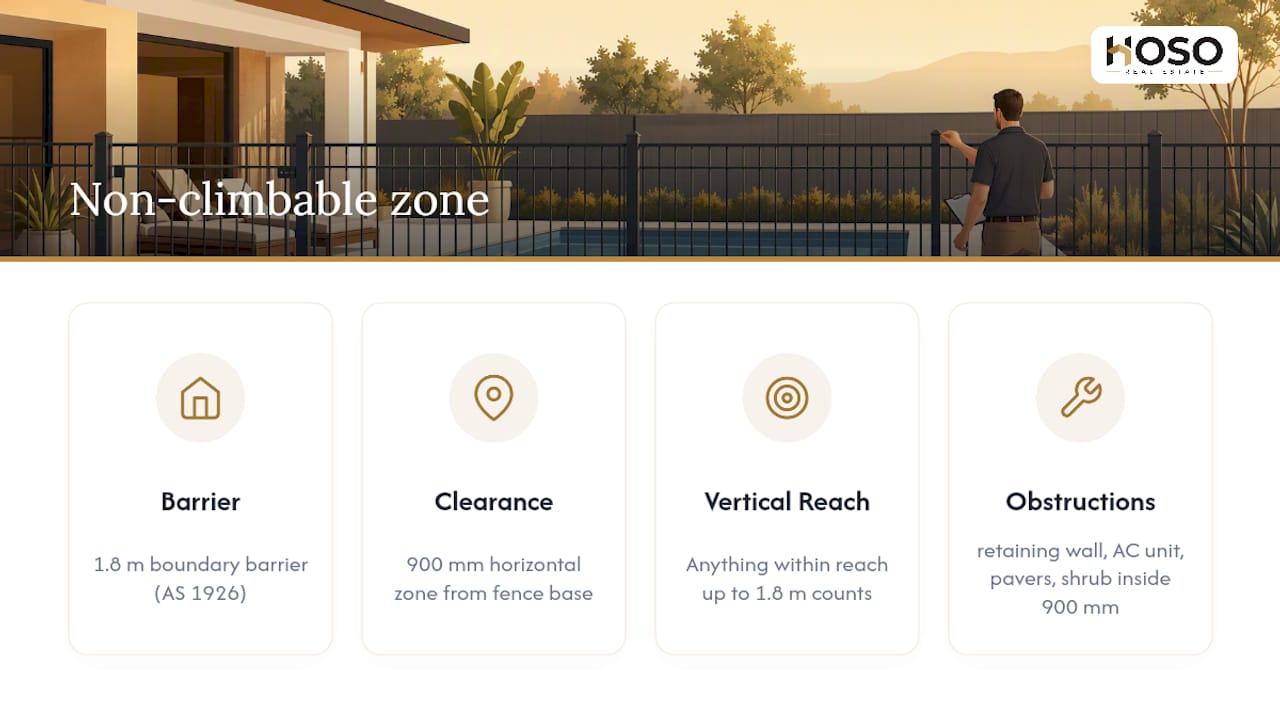
The non-climbable zone is the 900 mm buffer immediately outside (or inside, depending on configuration) a boundary fence used as part of a pool barrier, and it has to stay clear of anything a child could use as a foothold. This isn't a vague "keep it tidy" suggestion. It's measured precisely, and it's one of the first things a certifier checks with a tape measure.
The zone is measured horizontally from the base of the fence, extending 900 mm outward, and vertically it applies to anything within reach that could function as a step or ledge. A retaining wall, an air conditioning unit, a stack of pavers waiting to be laid, or even a sturdy shrub can all defeat the zone if they sit inside that 900 mm band and offer a usable foothold up to the required 1.8 metre fence height.
Where the ground itself slopes, the calculation gets trickier. A retaining wall that drops the effective fence height on one side, or a garden bed built up against the boundary, changes the maths on how tall the barrier actually is from a child's likely standing point. This is precisely where DIY assessments go wrong. Owners measure the fence itself and assume they've covered the requirement, without accounting for what's sitting in the 900 mm zone that effectively shortens the climb. A certifier trained to AS 1926 will check both dimensions together, not just the fence panel height in isolation.
What materials and construction standards apply to pool fences?
There's no single mandated material for a compliant pool fence in South Australia. Aluminium, steel, timber, and glass panels are all commonly used, and each is acceptably provided it meets the gap, height, and rigidity requirements set out in AS 1926.
The construction detail matters more than the material choice. Vertical pickets need gaps no wider than 100 mm to stop a small body squeezing through, and horizontal rails are restricted because they create an obvious climbing ladder if spaced incorrectly. Chain-link and mesh fencing face particular scrutiny, since the diamond pattern can double as a foothold unless the mesh is fine enough and the fence height compensates accordingly.
Fixings and durability count too. A fence panel that's structurally sound today but rusting at its base, or a timber paling fence with rotting posts, can fail a compliance check even if the original design met every dimensional requirement. Councils and certifiers look at current condition, not just original approval, which is why a fence that passed inspection in 2015 can still fail a pre-sale review in 2026 if it's deteriorated.
Anything attached to or near the fence also matters. A pergola post, a retractable clothesline, or a garden trellis fixed to the barrier can inadvertently create a climbing aid if it sits within reach of the non-climbable zone, even when the fence panel itself is textbook compliant.
Are glass pool fences held to different rules in South Australia?
Glass pool fences are permitted in South Australia and have become a popular choice for owners wanting an unobstructed pool view, but they carry their own set of construction checks layered on top of the standard height and NCZ rules.
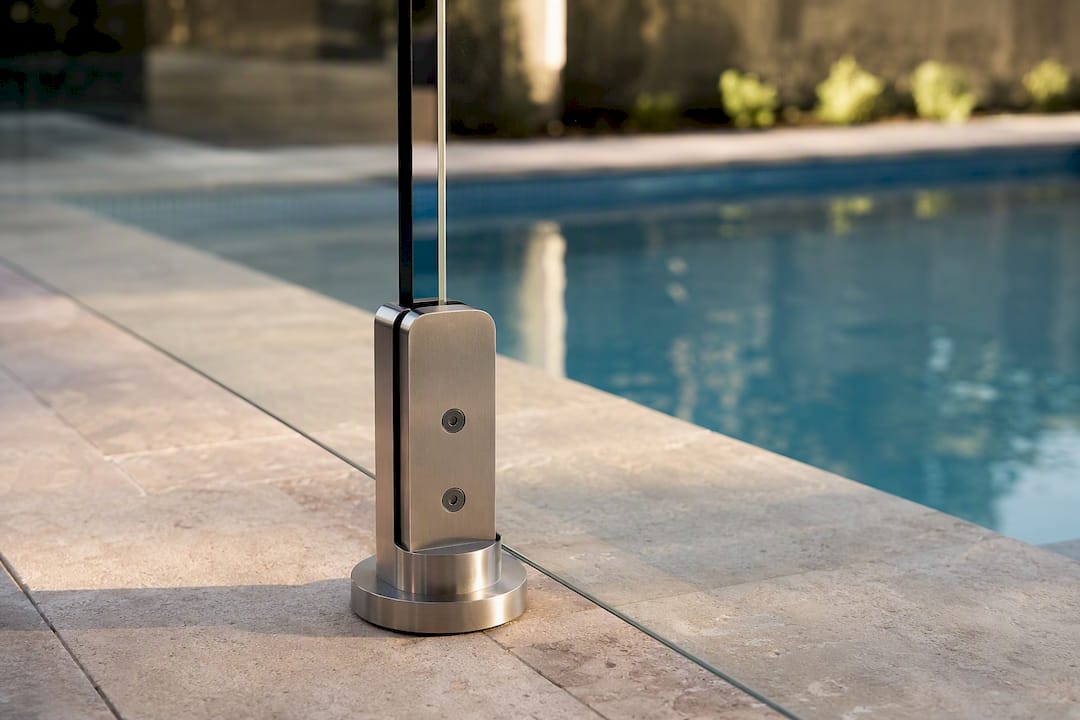
Frameless and semi-frameless glass panels must meet structural and safety glazing requirements, typically using toughened or laminated safety glass rated for the load and impact standards applicable to pool barriers. The glass itself needs to be free of climbable features, which sounds straightforward until you consider that some glass fence systems use visible horizontal capping rails or spigot fixings that could, depending on design, offer an inadvertent foothold if positioned poorly.
Gaps between glass panels are held to the same restrictions as any other fence type: no opening wide enough for a small child to squeeze through, and no gap beneath the panel that a child could crawl under. Ground clearance under a frameless glass fence is a frequent sticking point, since some installers leave a gap for drainage that ends up exceeding what AS 1926 permits.
Gate hardware attached to a glass fence system still needs the same self-closing, self-latching mechanism as any other gate, with the 1.5 metre latch height rule applying without exception. If you're considering a glass upgrade to an existing property, it's worth having a certifier review the specific product's compliance documentation before installation, rather than assuming a premium price tag guarantees compliance.
Who inspects pool fences, and what do they check?
Council officers hold the legislative authority to inspect and enforce pool safety requirements in South Australia, and they're the only party who can issue an enforcement notice for a non-compliant barrier. Private certifiers can inspect and report, but only council officers have the power to enforce compliance action.
The initial inspection happens after a new pool's barrier is complete and the council has been notified. Beyond that first check, inspections tend to happen at specific trigger points: a property sale, a complaint from a neighbour or passerby, or a council's own periodic compliance sweep of pools within its area.
What gets checked goes well beyond the fence height. An inspector will test the gate's self-close and self-latch function, measure the non-climbable zone for obstructions, check for gaps or climbable features along the entire fence line, and confirm any required CPR signage is visible and legible. They'll also look at the condition of the barrier, not just its original design, since rust, rot, or loose fixings can turn a compliant fence into a non-compliant one over a few Adelaide summers.
Private certifiers follow the same technical checklist during a voluntary pre-sale or periodic inspection, which is exactly why engaging one before you list a property, or before a council visit is even scheduled, tends to catch problems while they're still cheap to fix.
How do you get a compliance certificate or official approval?
There's no single centralised "pool compliance certificate" register in South Australia, but the practical path to demonstrating compliance follows a consistent sequence whether you're dealing with a new pool or preparing to sell an older one.
Start by engaging a private certifier or suitably qualified inspector to review the barrier against AS 1926 and MBS 004 requirements. They'll conduct a physical inspection covering fence height, gate hardware, the non-climbable zone, and any signage obligations, then issue a written report detailing what passes and what needs remediation.
If the report flags defects, the next step is arranging the repair work, whether that's adjusting a gate latch height, clearing furniture from the NCZ, or replacing a section of fencing with wider-than-permitted gaps. Once remediation is complete, a follow-up inspection confirms the fix, and the certifier can issue an updated report.
For new pool construction, this report typically accompanies your notification to council, which then conducts its own inspection within the mandated timeframe before the pool can legally hold water. For a property sale, that same certifier's report becomes the document you hand to your conveyancer, giving the buyer's solicitor confidence the barrier meets current standards before settlement locks in. Keep dated copies of every inspection report and remediation invoice, since a documented history carries real weight if a compliance question arises years later.
What happens if you ignore a non-compliant pool fence?
The $15,000 maximum penalty for sale-time non-compliance is the headline figure, but it's far from the only consequence an owner faces for ignoring a defective barrier.
A council that identifies a non-compliant fence, whether through a routine inspection, a neighbour's complaint, or a sale-triggered review, can issue a formal notice requiring rectification within a set timeframe. Ignoring that notice escalates the matter, potentially into further enforcement action under the Planning, Development and Infrastructure Act, since council officers hold the legislative power that private certifiers don't.
Beyond direct penalties, a non-compliant fence exposes the owner to civil liability if a drowning or near-drowning incident occurs. Given that most under-five drowning deaths in private pools are linked to barriers that didn't meet legislative requirements, an owner who knowingly left a gate propped open or a climbable obstruction in the NCZ faces a materially harder position in any subsequent legal claim or coronial inquiry.
Insurance is the less obvious risk. Home and landlord insurance policies often carry conditions requiring the property to meet relevant safety regulations, and an insurer investigating a claim after a pool-related incident may scrutinise whether the barrier was compliant at the time. A policy that would otherwise pay out can be contested, or a claim reduced, if the fence clearly failed basic AS 1926 requirements the owner had ample opportunity to fix.
HOSO's view: why compliance protects more than the pool
We treat pool compliance as a settlement issue, not just a safety checklist. A property that fails a pre-sale inspection loses negotiating leverage the moment a buyer's solicitor raises it, and that conversation happens at the worst possible time: mid-contract, with a deadline looming.
Our approach for landlords with pooled properties is straightforward. We coordinate certifier inspections on a proactive schedule, keep dated maintenance records that stand up to scrutiny, and flag remediation needs before they become settlement blockers. For interstate and overseas investors who can't personally check a gate latch each month, that oversight is where a managed portfolio earns its keep.
If you own an Adelaide investment property with a pool and want that compliance handled properly, explore our property management services and talk to our team about getting ahead of your next inspection cycle.
— HOSO
Sources
- Sa
- Pool Safety — Consumer and Business Services SA
- Planning, Development and Infrastructure (Swimming Pool Safety) Regulations 2019 (SA) - reg 6 — AustLII
- Swimming pool safety — Law Handbook (SA)
- SA G1P2 Swimming pool access and water recirculation systems — Australian Building Codes Board