
You cannot enforce a blanket ban on pets in South Australian rentals without valid statutory reasons. Refusals must rest on statutory grounds under the Residential Tenancies Act, or you approve with reasonable conditions. Immediately: log the request in a pet register, start a property suitability check, and diarise your response for day 14, because silence equals approval.
TL;DR:
- Landlords must respond to pet requests within 14 days in writing; failure to do so results in automatic approval without further reconsideration.
- Acceptance is only lawful if the property is genuinely suitable, free from legal or council restrictions, or if reasonable conditions are attached.
- Proper inspection involves documenting fence condition, yard size, finishes, and local rules with dated photos, and consistency in applying this checklist is crucial.
- Any breach by keeping an unapproved pet requires a formal remedy notice and solid evidence such as dated photos, quotes, or complaints before escalation.
- Reimbursement claims for pet damage should be based on a careful comparison of entry and exit condition reports, with invoices and a strict paper trail to support claims.
Table of Contents
- What does SA law actually require on pets in rentals?
- What should you inspect before approving a pet?
- How do you process a pet application without missing the deadline?
- What happens when a tenant keeps an unauthorised pet?
- How do you recover pet-related costs at the end of a tenancy?
- HOSO's practitioner note on pet compliance
- Let HOSO Real Estate handle your pet compliance workflow
- Sources
- FAQ
What does SA law actually require on pets in rentals?
The Residential Tenancies Act 1995 (SA) governs every pet decision you make, and the mechanics matter more than most landlords assume. Once a tenant lodges a written request, you have 14 days to respond in writing under section 66C. Miss that window, or send a non-compliant reply, and the pet is deemed approved. There is no second chance to revisit that decision later.
Refusal is only lawful on specific grounds. Consumer and Business Services (CBS) guidance and the Act list acceptable reasons, including:
- The premises are genuinely unsuitable for the animal (size, fencing, flooring).
- The number or type of animals poses a health or safety risk.
- Keeping the pet would breach another law, a council by-law, or a strata/community title rule.
- The tenant refuses to accept reasonable conditions you've proposed.
You can attach reasonable conditions to an approval. CBS's factsheet on renting with pets confirms these can include effective restraint during entry, keeping the animal outside if it wasn't ordinarily an indoor pet, and professional carpet cleaning at the end of the tenancy. What you cannot do is charge a separate pet bond, demand extra rent, or force the tenant to use a specific supplier. Those conditions are void the moment you write them.
What should you inspect before approving a pet?
A pet decision should never be a gut call. Walk the property with a structured checklist, because the suitability grounds you rely on later only hold up if you documented them at the time.
- Check the perimeter first. Measure fence height, test gate latches, and look for gaps a dog could squeeze through or a cat could scale. In older Adelaide bungalows around suburbs like Unley or Goodwood, sagging timber fencing is a common failure point.
- Assess yard size and council limits. Confirm the property meets any local by-law on the number of animals, and note whether strata or community title rules apply to units or townhouses.
- Inspect internal finishes. Carpet type, floating floorboards, flyscreens, and garden beds near entry points all tell you how much wear a pet is likely to cause.
- Capture dated evidence. Photograph every checkpoint, note it against the entry condition report, and flag anything a contractor should assess before you sign off.
The SA Legal Services Commission's handbook on pets points to gate latches, fence gaps, flyscreens, timber floors, and drainage as the practical details that decide whether a property is genuinely suitable, not just theoretically fine on paper.
Pro Tip: Run the same inspection checklist every time, even for a client's cat that "never goes outside." Consistency is what protects you if a decision is ever challenged at SACAT.
How do you process a pet application without missing the deadline?
Treat every pet request as a workflow with a clock attached, not a favour to weigh up at your leisure.
- Log the request the day it arrives, with the date stamped clearly.
- Run the property suitability check outlined above and note any strata or council restriction that applies.
- Draft your written response inside the 14-day window, stating either approval, conditional approval, or refusal with the specific statutory ground.
- If approving, spell out conditions plainly: effective restraint during entry, outdoor only where relevant, and professional carpet cleaning obligations at exit.
- If refusing, cite the exact ground from the Act, not a general preference against pets.
Every decision belongs in a dedicated pet register, recording the animal's description, the approval date, any conditions attached, and the property checks that supported the decision. This matters more than it sounds. If a tenant later swaps a small dog for a larger one, or adds a second animal, your register is the record that proves what was actually approved. This same discipline around dates and written responses is worth applying to broader rental application processes too.
What happens when a tenant keeps an unauthorised pet?
An undisclosed pet is a breach, but you still need to follow the correct notice pathway before escalating. Start with a Form 5 notice to remedy breach, giving the tenant the statutory timeframe to either remove the animal or lodge a proper application.
If the breach continues, SACAT's housing and rentals guidance is clear about what it expects to see before it will act:
- Dated photos from routine inspections showing damage or the animal's presence.
- Contractor quotes for repairs, cleaning, or pest treatment linked to the pet.
- A record of incidents, including any complaints from neighbours about noise or nuisance.
- Copies of all written communications with the tenant about the breach.
- Invoices for any remedial work already carried out.
Urgent termination is realistic only where there's serious damage or a genuine safety risk, and SACAT's guidance on serious breaches treats these as a higher bar than a routine breach. Weak or undated evidence is the single biggest reason these applications fail. The same evidence discipline applies to other tenancy issues, including subletting disputes that end up before SACAT.
How do you recover pet-related costs at the end of a tenancy?
Compare the entry and exit condition reports side by side before you claim anything. That comparison is what separates genuine pet damage from fair wear and tear, and SACAT will expect you to have made that distinction yourself, not assumed it.
- Get written quotes and keep every invoice for repairs or professional cleaning tied specifically to the pet.
- Frame the claim around the tenant's breach of a condition, referencing the exact term they agreed to.
- Never claim a separate pet bond, additional rent, or a mandatory supplier fee. Those conditions were void from the start, and claiming against them will undermine an otherwise solid application.
- Keep the maintenance standards you applied during the tenancy as a reference point for what "reasonable" repair looks like.
A property cleaning checklist built for pet-related turnovers can help you scope what a professional clean should actually cover before you commission the work.
HOSO's practitioner note on pet compliance
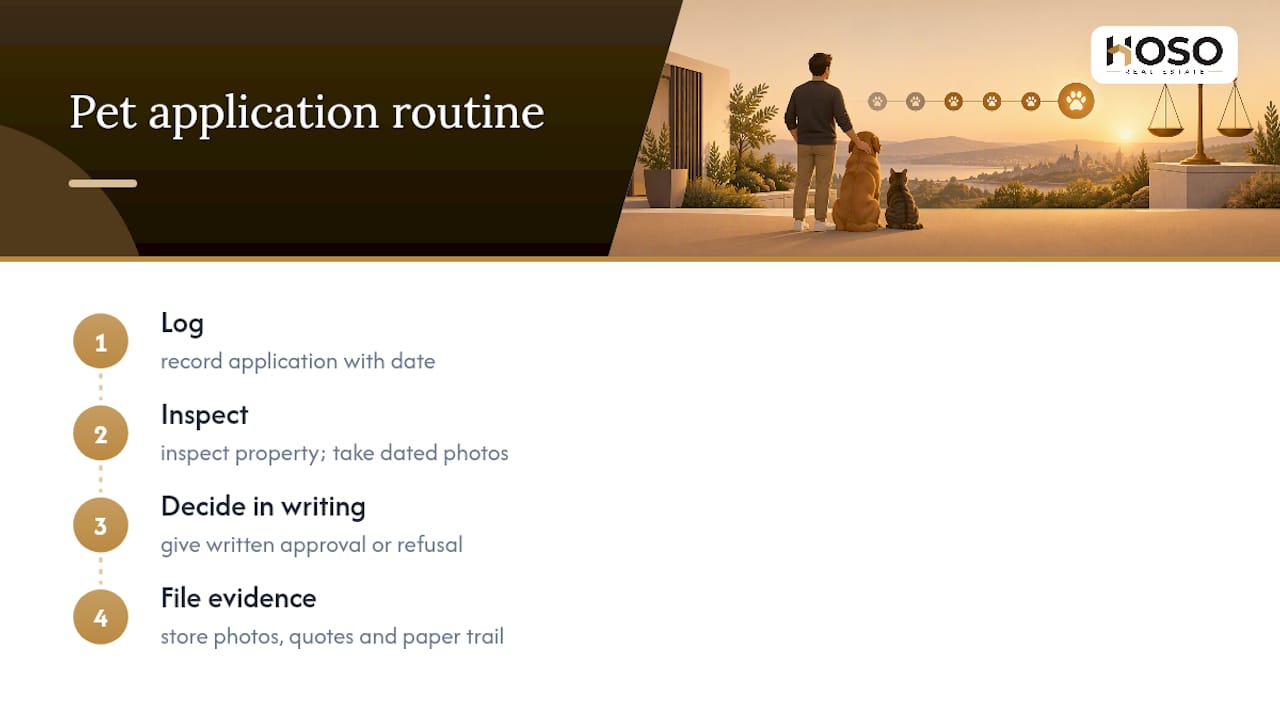
We've found that the landlords who avoid SACAT disputes over pets aren't the ones with the strictest rules. They're the ones with the tightest process. HOSO recommends a four-step intake and inspection routine tied to every pet application: log, inspect, decide in writing, and file the evidence, in that order, every time.
The difference between a claim that succeeds and one that gets dismissed almost always comes down to evidence discipline. Dated photos, contractor quotes, and a documented paper trail carry weight. A verbal recollection of "the carpet was fine when they moved in" does not.
— HOSO
Let HOSO Real Estate handle your pet compliance workflow
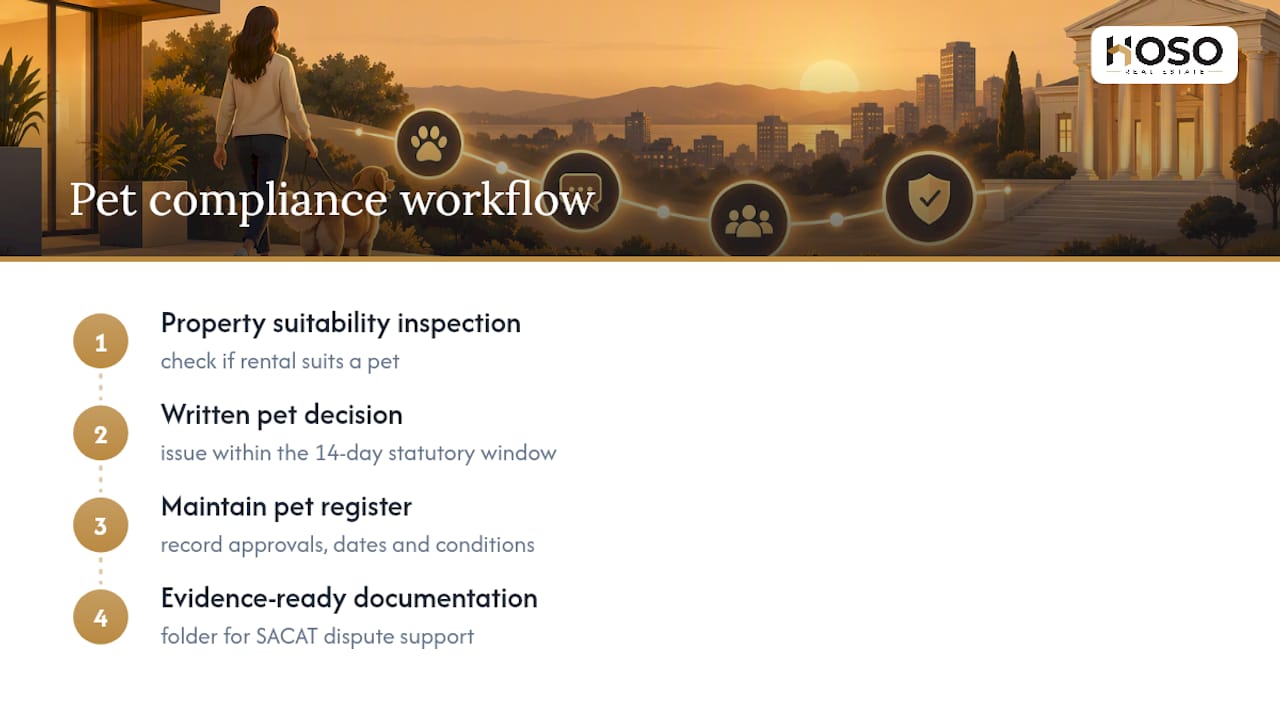
An alternative to managing pet approvals yourself, spreadsheet by spreadsheet, is to have a professional service help ensure you don't miss the 14-day deadline before it lapses into automatic approval. The full compliance workflow for Adelaide landlords can include property suitability inspections, written pet decisions inside the statutory window, a maintained pet register, and evidence-ready documentation if a dispute ever reaches SACAT. That's the difference between reacting to a breach and having the paperwork already sitting in a folder when you need it.
If you're weighing up whether your current property is even suited to a pet-friendly tenancy, or want a second opinion on how it's being managed now, start with a rental appraisal or explore our full range of property management services.
Sources
- Pets in private rental properties — SA Government
- Residential Tenancies Act 1995 (SA) s66C — AustLII
- Renting with pets: rights and responsibilities — Consumer and Business Services (CBS)
- SACAT — housing and rentals guidance
FAQ
Can a landlord refuse all pets in SA?
No. A blanket "no pets" clause isn't enforceable under SA tenancy law. Refusals must be tied to specific statutory grounds, such as unsuitable premises or a genuine safety risk.
What happens if I miss the 14-day response deadline?
The pet is deemed approved automatically under section 66C of the Act. There's no way to reverse that outcome after the fact, which is why logging the request date matters as much as the decision itself.
Can I charge a pet bond or extra rent for approving an animal?
No. Those conditions are void under the Act, along with forcing a tenant to use a specific supplier. Lawful conditions are limited to things like restraint during entry and professional carpet cleaning at exit, as set out in CBS guidance.
What evidence does SACAT expect for a pet-related claim?
SACAT looks for dated inspection photos, contractor quotes, written communications, and invoices tied directly to the alleged damage or breach. SACAT's own guidance treats undated or verbal evidence as far weaker than a documented paper trail.
Does HOSO Real Estate manage pet approvals for landlords?
Yes. HOSO Real Estate runs the inspection, decision, and recordkeeping workflow for pet applications as part of its property management services, including SACAT-ready evidence practices if a dispute arises.