
A lawful rental affordability check verifies a prospective tenant's capacity to pay rent using no more than two documents relating to their ability to pay, such as a payslip, a redacted bank statement, a Notice of Assessment, an employer letter, or a Centrelink statement. Landlords cannot demand transaction-level expenditure histories. Weigh the evidence against a rent-to-income benchmark of roughly 30% of gross income, and record every decision in a format that would hold up if a tenant ever challenged it at SACAT.
TL;DR:
- Landlords can only request two documents such as payslips or bank statements, and cannot ask for detailed expenditure histories or full bank transaction records.
- A tenant is generally considered affordable if their rent costs around 30% of gross income, with 33% as an upper limit, but adjustments are needed for household and savings factors.
- Checking both TICA and the National Tenancy Database helps identify tenancy issues that might be missed if only one database is used, especially since listings are lodged by individual agents.
- Income verification for self-employed applicants should involve ATO notices or accountant letters, along with a redacted bank statement showing income deposits.
- A consistent, documented screening process combining identity, income, database, references, and scoring reduces legal risks and ensures decisions are SACAT-ready.
Table of Contents
- What you can lawfully ask for when running rental affordability checks
- How do you calculate rent-to-income affordability?
- What do tenancy database and credit checks actually tell you?
- A step-by-step screening process you can run on every application
- Recording decisions so they hold up at SACAT
- Why rigorous screening protects premium portfolios
- How HOSO Real Estate handles screening and SACAT-ready documentation
- Primary sources for this guide
- Sources
- FAQ
What you can lawfully ask for when running rental affordability checks
South Australian regulation caps how far you can go. Under Reg 8 of the Residential Tenancies Regulations 2025, a prospective tenant cannot be required to hand over more than two documents relating to their ability to pay rent, and you cannot request financial information based primarily on their spending habits. That rules out full bank statement downloads showing every transaction. It also rules out asking for a full ledger of someone's grocery bills or subscriptions.
Best practice guidance backs this up: request only the minimum needed to confirm capacity to pay, and tell applicants plainly why you need it, according to Fair Trading Commissioner guidance. SA government guidance on choosing a tenant lists what counts as acceptable evidence:
- Two to three months of payslips
- A redacted bank statement showing salary deposits only, with transaction details and account numbers blacked out
- A Notice of Assessment or accountant letter for self-employed applicants
- An employer confirmation letter
- A Centrelink income statement
A simple request script works best: "To confirm you can comfortably cover the rent, please provide one payslip and one bank statement with transaction details redacted." Never charge applicants for these checks, and store what you collect securely, deleting it once the leasing decision is finalised and any statutory retention period has passed.
How do you calculate rent-to-income affordability?
Industry practice treats around 30% of gross household income as the useful affordability benchmark, with 33% commonly used as an upper bound before a tenancy is considered financially stretched, according to tenant screening guidance. A worked example makes this concrete:
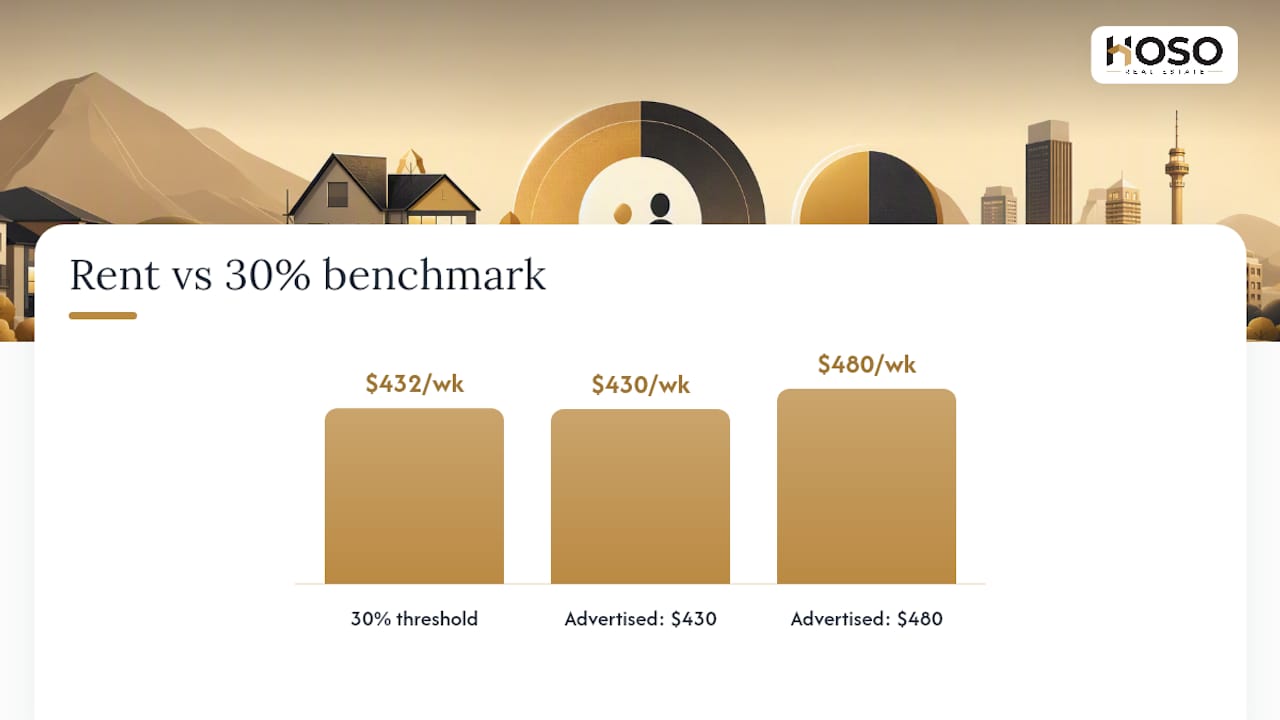
- Applicant earns $75,000 gross annually, or roughly $1,442 per week.
- Thirty percent of that weekly figure is $432.
- A property advertised at $430 a week sits comfortably inside the benchmark; one at $480 a week pushes past 33% and warrants a closer look.
Don't apply this mechanically. A couple with two incomes and no dependents can often sustain a higher ratio than a single-income household with children. Savings buffers matter too. An applicant with three months of rent sitting in savings presents differently to one living week to week, even at an identical income. Secure government payments, such as an aged pension or a stable Centrelink benefit, should be assessed on the same objective footing as wages rather than dismissed outright.
Where the numbers sit close to the line, a conditional approval can be reasonable. Options include a slightly larger bond within legal limits, a guarantor, or a shorter initial lease term with a review at renewal. This works better than a flat rejection when the applicant otherwise presents strongly on references and rental history.
Pro Tip: Cross-check the advertised rent itself before you assess affordability. A property priced above the local market immediately narrows your applicant pool to higher earners only. A current rental appraisal tells you whether the rent you're screening against actually reflects the suburb.
What do tenancy database and credit checks actually tell you?
TICA and the National Tenancy Database (NTD) are the two major tenancy databases in Australia, and they don't always carry the same listings, because entries are lodged by individual agents rather than pooled centrally. Checking both, where each is available, catches history that a single-database search would miss, a point industry screening guidance makes clearly.
A tenancy database listing and an Equifax credit default are different signals and should be read that way:
- A TICA or NTD listing usually relates to tenancy-specific conduct, such as unpaid rent, property damage, or an abandoned lease.
- An Equifax credit default relates to a missed repayment on a loan, credit card, or utility account, and says nothing directly about rental behaviour.
- A single old listing with a documented explanation carries less weight than a recent, unexplained pattern.
Bank statements themselves often reveal more than the headline income figure. Watch for frequent buy-now-pay-later repayments, recurring overdraft fees, or a pattern of dishonoured direct debits. None of these automatically disqualify an applicant, but they warrant a direct, respectful follow-up question rather than a silent rejection. Document what the databases returned, what you asked, and how the applicant responded, so the reasoning behind your decision is traceable later.
A step-by-step screening process you can run on every application
A defensible process follows the same sequence every time, which matters more than any single check in isolation. Thorough screening typically takes 60 to 90 minutes per application, and that time investment is what materially reduces eviction and vacancy risk down the track.
- Identity verification. Confirm photo ID matches the application and matches the name on payslips or bank documents.
- Income verification. Collect the two permitted documents, cross-checking employer details against payslip letterhead. For self-employed applicants, request an ATO Notice of Assessment or an accountant's letter confirming income.
- Tenancy database checks. Search TICA and NTD, noting any listings and their dates.
- Credit check. Run an Equifax check where used, to flag defaults separate from tenancy history.
- Reference checks. Contact current and previous property managers or landlords, using a structured reference form like Form A1 to keep responses consistent and SACAT-ready.
- Scoring. Apply a weighted scorecard rather than a gut call.
- Decision and record. Document the outcome, whether approved, conditionally approved, or declined, with the reasoning attached.
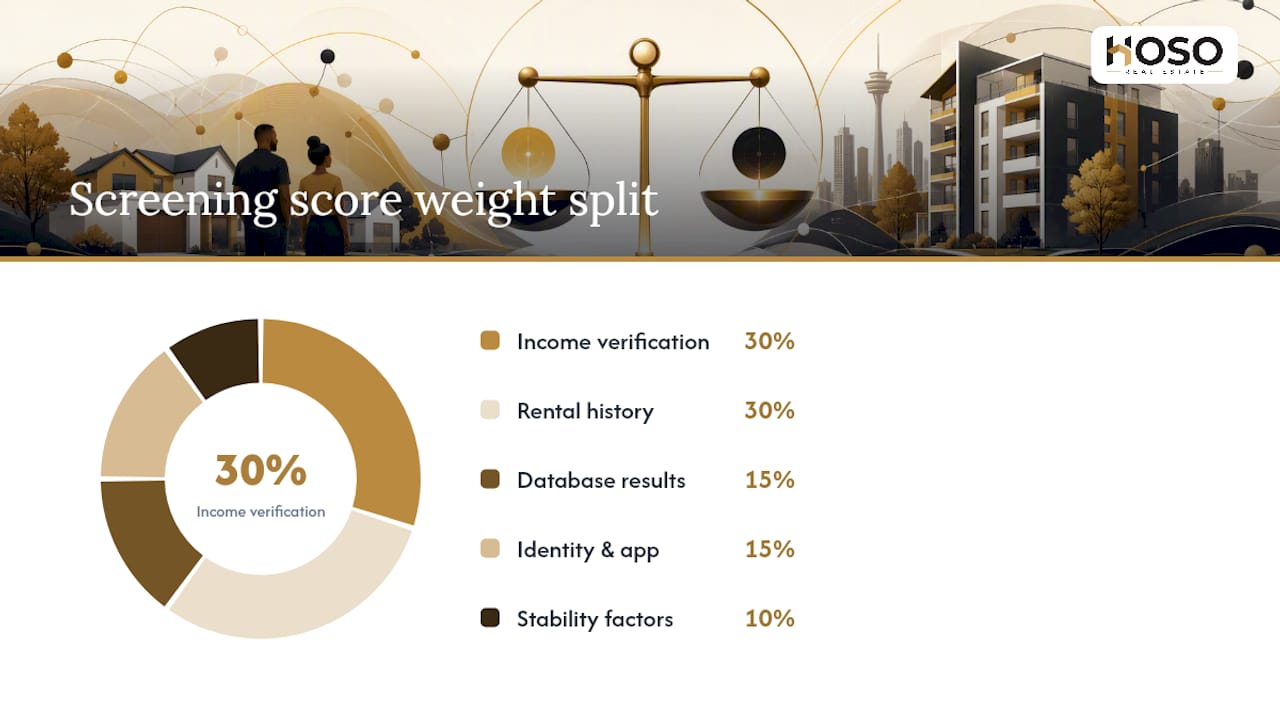
A simple weighted model might allocate income verification 0.30, rental history and references 0.30, database results 0.15, identity and application completeness 0.15, and stability factors like employment tenure 0.10. Scores above a set threshold proceed to approval; scores in a middle band trigger a conditional offer; low scores are documented and declined on objective grounds, never on a protected attribute.
Follow-up questions belong in the process, not as an afterthought. If a database listing appears, ask the applicant directly for their account before assuming the worst. This single step often resolves genuine misunderstandings and keeps your decision defensible.
Recording decisions so they hold up at SACAT
Retain every piece of evidence you assessed, redacted as required, alongside notes from calls or emails, your completed scorecard, and the database search results with timestamps. This is the material that turns a subjective impression into an objective, reviewable record.
A concise SACAT-ready brief pulls these together in one place:
- The two documents used to verify ability to pay
- TICA and NTD search results and dates
- Reference check notes, ideally captured on a structured form such as Form A1
- The completed scorecard and final decision rationale
Keep this brief for as long as your record-retention obligations require, and store it separately from general correspondence so it can be produced quickly if a dispute arises. A SACAT-ready tenant selection checklist helps standardise this across every application you assess.
Why rigorous screening protects premium portfolios
Landlords holding higher-value Adelaide properties, from character homes in Unley to newer builds in Lightsview, carry more financial exposure per vacancy or default than the average rental. That's exactly why disciplined, documented screening matters more here, not less.
HOSO Real Estate applies a four-layer tenant screening approach precisely because a single check, run in isolation, misses too much. Income verification alone won't catch a tenancy database pattern; a clean database result alone won't confirm someone can actually service the rent. Combining income, database, reference, and identity checks, then recording each step, is what makes a decision defensible months later if it's ever tested.
For landlords managing a portfolio, or those based interstate or overseas without the local presence to chase down redacted documents and reference calls, engaging a property manager to run this process consistently is usually the more reliable path than doing it ad hoc between other commitments.
— HOSO
How HOSO Real Estate handles screening and SACAT-ready documentation
HOSO Real Estate is the alternative to running affordability checks yourself between tenancy applications and everything else your portfolio demands. Our HPTS Tenant Screening process applies the four-layer approach outlined above to every applicant, and every reference check runs through a Form A1 style structure built to be SACAT-ready from day one, not reconstructed after a dispute lands.
For landlords who want the same discipline applied across leasing, rent collection, inspections, and compliance, our full property management and tenant placement services cover the entire tenancy lifecycle under one point of contact. If you're deciding whether your current rent reflects what the market will actually bear before you screen against it, an appraisal is the sensible first step. Browse our recently leased Adelaide properties to see the calibre of tenants placed through this process, then get in touch to discuss your portfolio.
Primary sources for this guide
- Residential Tenancies Regulations 2025, Reg 8
- Fair Trading Commissioner guidance
- SA government tenancy guidance
- Related reading: preparing a rental property for long-term tenants
Sources
- RESIDENTIAL TENANCIES REGULATIONS 2025 - REG 8
- When a prospective tenant applies for a property — Fair Trading guidance
- Choosing a tenant — SA government guidance
- Tenant Screening Melbourne 2026 | OptimaRea
FAQ
How Many Documents Can I Request for a Rental Affordability Check?
No more than two documents relating to ability to pay rent, under Reg 8 of the SA Residential Tenancies Regulations. Full transaction-level bank statements or expenditure histories are not permitted.
What Rent-to-Income Ratio Should I Use?
Around 30% of gross income is the standard guideline, with 33% treated as a practical upper bound, according to tenant screening industry guidance. Adjust for savings buffers, household composition, and secure income sources.
How Do I Verify Self-Employed Applicants' Income?
Request a current ATO Notice of Assessment or a letter from their accountant confirming income, alongside a redacted bank statement showing regular business income deposits.
Should I Check Both TICA and NTD?
Yes. Listings are lodged individually by agents, so checking both databases catches history a single search could miss.
What Should I Do if Affordability Checks Raise Concerns?
Consider a conditional approval, such as a guarantor, a shorter initial lease, or a bond adjustment within legal limits, rather than an outright rejection, particularly where references and rental history are otherwise strong.
Does HOSO Real Estate Handle Tenant Affordability Screening?
Yes, HOSO Real Estate's HPTS Tenant Screening service applies a four-layer verification process, with reference checks structured for SACAT readiness.