
A leasing fee is a one-off charge for placing a new tenant. A management fee is an ongoing cost, usually charged as a percentage of weekly rent, that pays for the day-to-day running of the tenancy. Confusing the two is where most fee disputes start.
Understanding the split matters for your bottom line, not just your paperwork.
- The leasing fee is billed once per tenancy, whenever a new tenant moves in.
- The management fee is billed continuously, as a percentage of rent collected, for as long as the tenancy runs.
- Both are generally deductible against rental income in the year they're incurred, but the timing differs, which affects how you plan your annual return.
The rest of this guide breaks down what each fee actually buys you, how to work out your true annual cost, and what South Australian consumer protection law says about getting it all in writing.
Key Takeaways
The leasing fee is a one-off cost paid per tenancy, while the management fee is an ongoing percentage of rent, and the true annual cost only becomes clear once both are combined with turnover and ancillary charges.
| Point | Details |
|---|---|
| Two fees, two timings | The letting fee is one-off per tenancy; the management fee runs continuously as a percentage of rent collected. |
| Turnover drives real cost | Frequent tenant changes multiply letting fees, pushing all-in annual cost toward 9% to 14% of rent. |
| Demand the written schedule | Insist every fee and inclusion appears in the signed management authority, not a verbal promise. |
| Escalate through SACAT | South Australian landlords can raise unresolved fee disputes with SACAT once documented in writing. |
| HOSO's transparent model | HOSO Real Estate provides fully itemised fee schedules and proactive tenant selection to reduce vacancy-driven costs. |
Table of Contents
- Leasing fee vs management fee: what the letting charge covers
- Leasing fee vs management fee: what ongoing management pays for
- How the two fees stack up over a full tenancy cycle
- Comparing quotes and negotiating the real number
- South Australian consumer protection: what to do if a manager overcharges
- Residential vs commercial: how the fee structure changes
- How these fees shape the tenant experience and your responsibilities
- Editorial take: the conventional advice on fees is incomplete
- Sources
Leasing fee vs management fee: what the letting charge covers
The letting fee is the cost of finding and installing a tenant. It's a separate transaction from ongoing management, even when the same agency handles both.
A genuine letting service should include:
- Professional photography and a listing across major rental portals
- Coordinating and running open inspections
- Processing applications and running tenant screening checks (rental history, employment, references)
- Preparing the lease agreement and bond lodgement paperwork
- Completing a detailed ingress condition report with photos, used later to assess wear and damage
Letting fees are typically structured as either a fixed dollar amount or 1 to 2 weeks' rent, charged whenever a new tenancy begins, whether that's the first let on a new investment or a re-let after a tenant vacates. This is the point where cost-to-serve starts compounding: a property with high turnover pays this fee far more often than a stable, long-term tenancy.
Before signing anything, insist on seeing the letting fee written into the management authority itself, not described verbally by a property manager during a sales pitch. Ask specifically whether the ingress report and screening checks are included in that fee or charged separately, and whether there's a reduced rate for an internal transfer (an existing tenant moving to another property you own with the same agency).

Pro Tip: Ask your prospective agency exactly how many letting events your property is likely to have per year based on their average tenancy length. A manager with strong tenant retention data is telling you, indirectly, how often you'll actually pay this fee.
Leasing fee vs management fee: what ongoing management pays for
Once a tenant is in place, the management fee takes over — learn more about property management explained. It funds the continuous administrative and operational work that keeps the tenancy running smoothly and your asset protected.
Core duties typically covered include:
- Collecting rent and reconciling arrears
- Coordinating repairs and maintenance requests with tradespeople
- Communicating with tenants on day-to-day issues
- Conducting routine inspections and reporting back to you
- Preparing monthly and end-of-financial-year owner statements
Management fees are almost always calculated as a percentage of the gross weekly rent actually collected, not a flat monthly charge. National ranges sit roughly between 5% and 12%, with capital-city averages closer to 6% to 8%. That structure has a practical consequence many landlords overlook: during a vacancy, there's no rent to apply the percentage to, so the management fee effectively pauses. It's the letting fee and lost rent that hurt during a gap between tenants, not the management fee.
What's often carved out of the headline percentage: routine inspection fees, lease renewal fees, and SACAT tribunal attendance if a dispute escalates. These line items vary enormously between agencies, and they're where a "cheap" headline rate can quietly become expensive.
How the two fees stack up over a full tenancy cycle
Comparing agencies on headline percentage alone is like comparing petrol prices without checking fuel efficiency. What actually determines your annual cost is the combination of the management percentage, how often you pay the letting fee, and how many ancillary charges get added on top, a total often referred to as cost-to-serve.
Here's a worked example using a representative Adelaide rental.
- Take a property renting at $550 per week, or $28,600 annually.
- Apply a management fee of 7% of rent collected: roughly $2,002 for the year.
- Add one letting fee at two weeks' rent for a single tenant turnover during the year: $1,100.
- Add typical ancillary charges: an annual statement fee, one lease renewal, and one routine inspection outside the standard schedule: say $250 to $350 combined.
- Total annual cost: approximately $3,350 to $3,450, or roughly 12% of annual rent.
That figure lines up with worked calculations from independent property cost guides, which put the all-in annual cost at roughly 9% to 14% of annual rent depending on turnover and local charges.
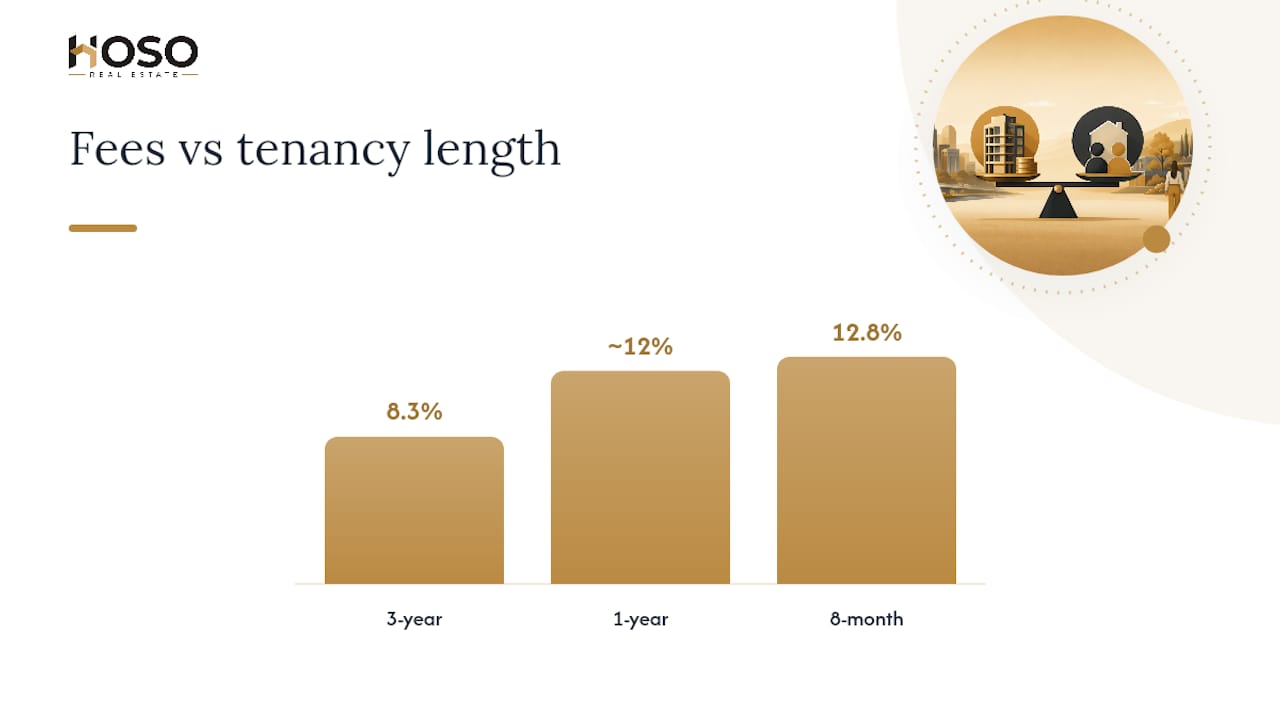
The variable that moves this number most isn't the management percentage, it's turnover. A property that changes tenants every eight months pays the letting fee nearly twice as often as one with a stable three-year tenancy, which can push the effective cost several percentage points higher even with an identical headline rate. This is exactly why experienced principals look at an agency's historical vacancy and re-let data before comparing fee percentages at all, since past turnover patterns predict future letting frequency far better than a quoted number on a brochure.
Comparing quotes and negotiating the real number
A fee comparison built on headline percentages alone tells you almost nothing. What you need is a full itemised schedule showing every charge you could possibly incur across a tenancy.
- Request a written breakdown of every fee: management percentage, letting fee, statement fee, inspection fee, lease renewal fee, and any tribunal representation charge.
- Check that each item is worded into the management authority itself, not left as a verbal assurance.
- Ask what's included in "marketing", specifically whether premium portal listings or professional photography carry extra charges.
- Confirm whether inspection frequency beyond the standard schedule attracts an additional fee, and if so, how much.
- Compare the fully itemised total, not the headline percentage, against at least two other agencies operating in your suburb.
On negotiation, a few levers genuinely move the number. Multi-property owners can often secure a discounted percentage across a portfolio. Bundling services (letting plus management with the same agency) sometimes offsets a slightly higher headline rate with lower ancillary charges elsewhere, and that bundled structure can work out better value than a low headline rate stacked with many small extras. Ask about capping the number of chargeable inspections or renewal fees per year, and ask whether standard advertising costs are absorbed into the letting fee rather than billed separately.
Small ancillary charges, statement fees, admin fees, and tribunal representation costs are often more negotiable than landlords realise, particularly on higher-rent properties or multi-property portfolios. Push to get these capped or removed in writing rather than accepting them as fixed.
Pro Tip: If two agencies quote different headline percentages, ask each for their average annual letting-event frequency and their itemised ancillary list before you compare a single number. The true cost only becomes visible once you multiply those figures out.
Red flags worth walking away from: an agency that won't put a specific figure against every line item, verbal promises about "no extra charges" that don't appear in the authority, or a refusal to explain what a "marketing fee" actually buys. For a structured framework on this comparison, see how to compare property management quotes before signing anything.
South Australian consumer protection: what to do if a manager overcharges
South Australian law requires that fees and inclusions be stated clearly in the written management authority you sign. An agency that quotes one figure verbally and charges another is exposing itself to a dispute it will likely lose, provided you have the paperwork to prove it.
Consumer protection guidance is consistent on this point: oral promises alone are weak evidence in a dispute, which is exactly why every fee item, GST treatment, and inclusion needs to sit in the signed contract, not a conversation you had over the phone.
If you believe you've been overcharged or the agency has misstated inclusions:
- Request a written, itemised statement showing exactly what was charged and when.
- Compare it line by line against your signed management authority.
- Raise the discrepancy with the agency in writing and request correction within a set timeframe.
- If unresolved, escalate to SACAT, South Australia's tribunal for residential tenancy and consumer disputes.
- Keep every email, statement, and version of the authority you've signed. Documentation is what wins these disputes, not the strength of your argument.
For a deeper look at how fees should be documented specifically for SA landlords, see this guide to property management fees for SA landlords.
HOSO's perspective: why transparent contracts protect returns
HOSO Real Estate builds every management authority around a fully itemised schedule, because landlords who can see the total cost-to-serve up front make better decisions than those working off a headline percentage alone. A well-selected tenant and a shorter vacancy period do more for annual returns than a marginally lower fee ever will, since reducing vacancy and tenant risk is where the real value of good management sits, not in shaving a percentage point off the headline rate.
- Every fee and inclusion is documented in the authority before signing, not described verbally.
- Proactive marketing and tenant screening are designed to shorten time between tenancies and reduce how often the letting fee is triggered.
- Portfolio owners are assessed on total annual cost, not a single line item.
A landlord comparing two quotes should ask which agency's tenant selection and vacancy record will actually cost less over three years, not which one has the lower number on the first page.
Residential vs commercial: how the fee structure changes
Residential and commercial property management run on different fee logic, and conflating them leads to unrealistic expectations on either side.
Residential fees, as covered throughout this guide, follow a fairly standardised model: a percentage-based management fee plus a one-off letting fee per tenancy, usually structured as weeks of rent. The residential market has enough volume and comparable stock that these percentages are broadly consistent across agencies in the same area.
Commercial property management works differently. Leases run longer, often three to ten years with option periods, so the letting event happens far less frequently, but the arrangements around it are more complex: bank guarantees instead of standard bonds, outgoings reconciliation, make-good clauses, and often a leasing commission calculated differently to a residential letting fee. Because commercial tenancies involve fewer transactions but larger dollar values and heavier legal review, fee structures tend to be negotiated individually rather than quoted off a standard schedule.
For a residential landlord, the practical takeaway is this: don't benchmark your management fee against a commercial building down the road, and don't assume a commercial-style leasing commission applies to your rental. The two markets are priced on entirely different risk and volume profiles, and mixing them up when comparing quotes will only confuse the comparison you're actually trying to make.
How these fees shape the tenant experience and your responsibilities
The way fees are structured has a direct, if often invisible, effect on how tenants experience your property and what remains your responsibility as the owner.
A well-resourced management fee typically buys faster response times on maintenance requests, which matters enormously to tenant satisfaction and retention. Tenants who wait weeks for a repair are tenants who don't renew, and every non-renewal triggers a fresh letting fee for you. In that sense, a management fee that funds genuinely responsive maintenance coordination is doing double duty: it keeps tenants content and it reduces how often you pay for a new tenancy altogether.

Your responsibilities as a landlord don't disappear once you sign a management authority, they shift. You remain legally responsible for the property meeting minimum housing standards and for approving significant repair costs, while your manager becomes responsible for day-to-day communication and coordination on your behalf. A cheap fee structure that leaves inspections infrequent or maintenance slow doesn't just risk tenant complaints, it risks your compliance obligations quietly slipping because nobody's watching closely enough.
Landlords who understand this connection tend to view the management fee less as an expense and more as insurance against the much larger cost of a vacant property, a damaged reputation, or a tribunal matter that a proactive manager would have prevented.
Editorial take: the conventional advice on fees is incomplete
Most guidance on this topic stops at defining the two fees and quoting a percentage range. That's not wrong, but it's not useful either. The number that matters is the annual dollar figure a landlord actually pays across a full tenancy cycle, and that number depends far more on turnover and ancillary charges than on the headline management percentage everyone fixates on.
The conventional advice to "shop around for the lowest percentage" often produces a worse outcome. A slightly higher headline rate from an agency with strong tenant retention and a genuinely itemised schedule can easily beat a lower rate stacked with letting fees, admin charges, and inspection surcharges that only reveal themselves after signing.
If you take one thing from this guide, prioritise the written schedule over the quoted number. Ask for every fee in writing, ask how often the letting fee is likely to trigger based on the agency's own retention data, and judge the total, not the headline. That single habit will save Adelaide landlords more money over a three-year tenancy than any amount of percentage haggling.
— HOSO
How HOSO can help: request a written fee schedule
If you're comparing agencies on gut feel rather than a genuine itemised breakdown, you're negotiating blind. HOSO Real Estate builds every management authority around a fully documented fee schedule from day one, so Adelaide landlords know exactly what they're paying for before a single tenant moves in, not after the first surprise statement arrives. Our approach to proactive marketing and tenant screening is designed to shorten vacancy periods and reduce how often a letting event needs to happen at all, which is where the real cost savings sit over a multi-year tenancy. Whether you own a single investment in Norwood or a growing portfolio across the eastern suburbs, you deserve a contract you can actually read and trust. Visit HOSO Real Estate's property management and leasing services to request a written fee schedule review and see exactly how a transparent, itemised approach compares to what you're paying now.
Sources
- How much do property managers charge? (LocalAgentFinder)
- Property management fees: A principal's guide (PMVA)
- Property management fees in Australia: What you'll actually pay (YourPropertyGuide)
- Using a property manager or real estate agent (Consumer Affairs Victoria)