
Six clauses decide whether a management agreement protects your property or quietly exposes it: scope of appointment, fees and payment handling, authority and maintenance limits, trust account and bond procedures, term and termination rights, and insurance and liability. Check these before anything else. A property manager agreement defines scope of services, fees, authority and obligations between you and the agency, and it should be tailored to your specific property, not copied from a generic template.
Before you read a single clause in detail, do two things: confirm the agent's licence and nominated licensee-in-charge, and ask for evidence of how trust account funds are held and reconciled. These two checks tell you more about risk than any amount of clause reading.
- Verify the agent's licence number and nominated licensee-in-charge.
- Ask for a recent trust account reconciliation or a description of the reconciliation process.
- Read the term, termination and fee-handling clauses before signing anything.
- If you want to change terms, work through a structured negotiation checklist rather than negotiating clause by clause on the spot.
Key Takeaways
The clauses that carry the most risk for owners are authority limits, trust account handling, and termination mechanics, and each should be checked before anything else in the agreement.
| Point | Details |
|---|---|
| Verify licence first | Confirm the agent's licence number and nominated licensee-in-charge before reading further clauses. |
| Set a maintenance ceiling | Negotiate a specific dollar threshold requiring your written approval, with emergencies defined separately. |
| Demand trust transparency | Require monthly reconciliations and clear bond lodgement evidence in writing. |
| Limit automatic renewal | Replace open-ended rollover clauses with short, explicit renewal periods you control. |
| HOSO Real Estate's approach | HOSO Real Estate builds agreements with defined authorisation ceilings, monthly reconciliations and documented handover timelines as standard owner protections. |
Table of Contents
- What are the essential clauses in a management agreement?
- What does each clause actually mean for you as owner?
- What red flags should make you pause before signing?
- How do you negotiate a management agreement effectively?
- What should happen when the agreement ends?
- What compliance evidence should you expect from your agent?
- How HOSO Real Estate structures owner protections into every agreement
- Where to find official guidance and templates
- What most advice about management agreements gets wrong
- A clearer path to a management agreement that actually protects you
- Frequently asked questions
- Sources
What are the essential clauses in a management agreement?
Every management agreement, regardless of the agency, should cover eight areas. Miss any one of these and you are relying on goodwill rather than a signed obligation.
- Appointment and scope. This defines exactly what the manager will do, which property or properties are covered, and whether the appointment is exclusive. It should also state whether the manager can subcontract tasks like maintenance coordination to third parties.
- Term and renewal mechanics. Most agreements run for a fixed term, then either lapse, require renewal, or roll over automatically. The notice period required to end the arrangement after the initial term matters more than the initial term length itself.
- Fees and payment handling. The agreement should disclose how rent and outgoings are collected, when funds are disbursed to you, and what can be deducted from rent proceeds without your prior sign off.
- Authority and maintenance limits. This sets the dollar threshold below which the manager can approve repairs without contacting you, and how "urgent" or "emergency" repairs are defined and evidenced.
- Trust account and bond handling. Rent and bond money must sit in a regulated trust account, separate from the agency's operating funds, with defined reconciliation and disbursement procedures.
- Insurance, liability and indemnities. This clarifies what the manager must hold (professional indemnity, public liability) versus what you as owner are expected to maintain, plus any caps on the manager's liability.
- Reporting and record-keeping. How often you receive financial statements, inspection reports, and correspondence records, and how long those records are retained.
- Dispute resolution and governing law. The mediation steps required before escalation, and which tribunal and jurisdiction apply if a dispute can't be resolved directly.
A minimum-standard agreement includes appointment, term, fees, authority, reporting, insurance, termination and dispute resolution as baseline elements. If any of these eight are missing or vaguely worded, treat that as a gap to raise before signing, not after.
What does each clause actually mean for you as owner?
Legal drafting tends to bury the practical implications inside formal language. Here's what the common wording actually means, and the exact question to ask if the clause doesn't answer it clearly.
Appointment and scope. Look for the specific property address, whether the appointment is exclusive, and whether subcontracting is permitted for trades or inspections. Tailoring matters here: a residential appointment clause differs materially from one written for a commercial or strata asset, because repair authority and access rules change with the property type.
Ask: "Is this appointment exclusive, and does it name every property it covers?"
Fees and payment handling. Rather than the figures themselves, check the mechanics: when invoices are raised, how GST is treated, and which categories of expense the manager can pay directly from rent before you see the invoice.
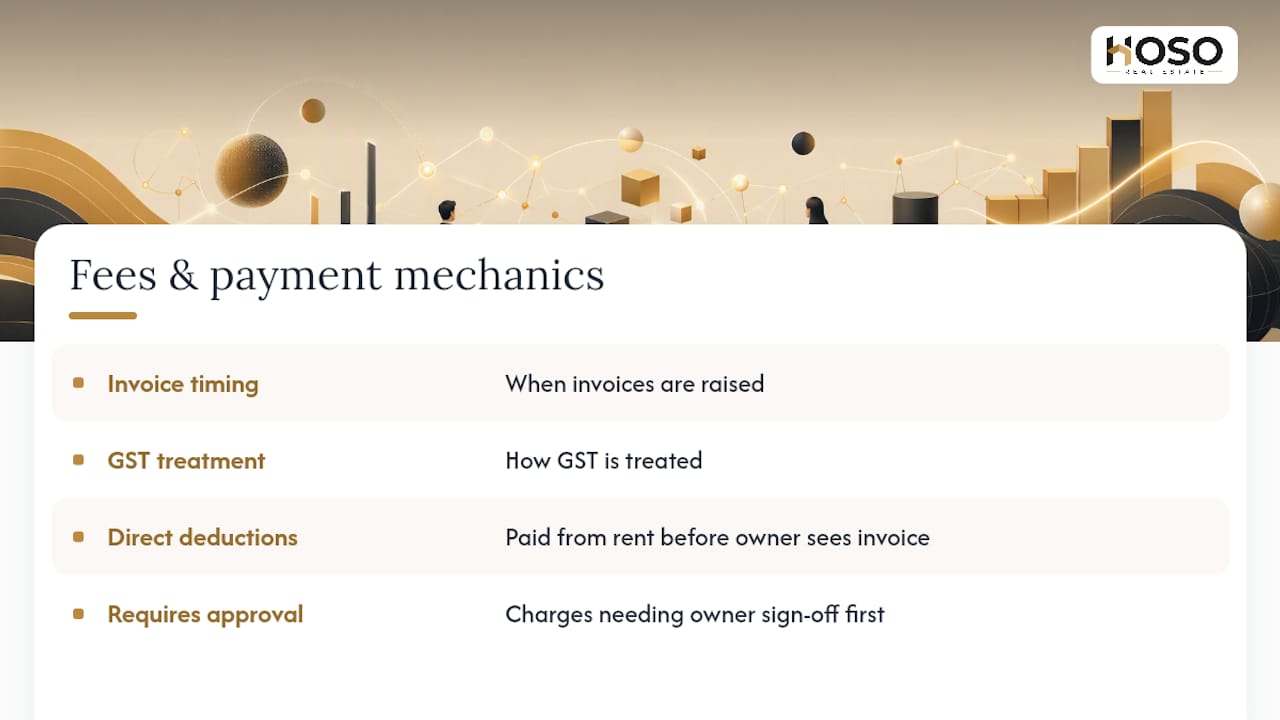
Ask: "Which charges can be deducted from rent proceeds without my approval, and which require my sign off first?"
Authority to act. This is where owners lose the most control without realising it. A clause that lets the manager "arrange urgent repairs as required" without a defined dollar ceiling is an open cheque book. Reasonable agreements set a clear approval threshold and separate "emergency" (burst pipes, safety hazards) from routine maintenance that can wait for your sign off.

Ask: "What dollar threshold triggers a requirement for my written approval, and how is an emergency repair defined and evidenced?"
Trust account and bond handling. Every dollar of rent and every bond must move through a dedicated trust account, reconciled against tenant ledgers on a regular cycle. Bond money is lodged with the relevant authority, not held by the agency. Ask specifically who signs off on bond claims, because this is often where disputes surface at the end of a tenancy.

Ask: "Where is the bond lodged, who signs bond claims, and how often is the trust account reconciled?"
Insurance, liability and indemnities. The agreement should separate what the manager insures (typically professional indemnity and public liability for their own conduct) from what you as owner must maintain (landlord insurance, building cover). Watch for liability caps that shield the manager from responsibility even in cases of clear negligence.
Ask: "What insurance must I maintain, and what does the manager hold in their own name?"
Reporting and records. Statement frequency varies, but monthly financial statements paired with documented routine inspections is the reasonable standard. Ask how long records like correspondence, invoices and inspection photos are retained, since these become evidence if a dispute or a SACAT matter arises later.
Ask: "How often will I receive financial statements and inspection reports, and how are they delivered?"
Dispute resolution and governing law. Most agreements require an internal complaint or mediation step before either party can escalate. For South Australian properties, that escalation path generally leads to SACAT rather than a general civil court, and the agreement should name that jurisdiction explicitly.
Ask: "Which tribunal has jurisdiction over disputes involving this property, and what mediation steps come first?"
Execution and formalities. If the property is held in a trust, company, or by joint owners, check who is authorised to sign the agreement and whether evidence of that authority (a trust deed extract, company constitution reference) is required. A sample execution clause from an industry template typically requires signatures from all named owners or a nominated authorised representative.
Ask: "Who needs to sign this agreement given how the property is held, and is proof of signing authority required?"
Pro Tip: Print the agreement and write your question directly in the margin next to each clause before your first meeting with the agency. It forces you to read every line rather than skim to the signature page.
What red flags should make you pause before signing?
Most problematic clauses aren't illegal, they're just written to favour the manager over the owner when things go wrong. Watch for these patterns:
- Undisclosed third-party commissions. Marketing mark-ups or trade referral commissions that aren't disclosed upfront can quietly inflate your costs without you ever seeing the underlying invoice.
- Vague "urgent repairs" language. A clause allowing "necessary repairs" without a defined dollar ceiling or a clear emergency definition gives the manager open spending authority.
- Excessive exclusivity or long auto-renewal periods. An agreement that locks you in for years with automatic rollover and no simple exit path limits your ability to switch managers if service quality drops.
- Assignment or novation without consent. Some agreements let the managing agency transfer your file to another business or franchisee without asking you first. You should always retain the right to approve or decline any such transfer.
- Thin trust-account detail. If the agreement doesn't specify reconciliation frequency or how bond funds are lodged, that silence is itself a warning sign, not a neutral omission.
- Termination penalties dressed up as "compensation." Watch for exit fees framed as compensation for the manager's "loss of future earnings" rather than a genuine, itemised cost of an early exit.
How do you negotiate a management agreement effectively?
Negotiating a management agreement doesn't mean rewriting it clause by clause during a meeting. It means walking in with a short, prioritised list of the changes that actually matter, and asking for them in writing.
- Check licence and trust-account evidence first. Request written confirmation of the agent's licence number and how trust reconciliations are performed, and ask for this to be referenced in the agreement itself, not just verbally confirmed.
- Set a firm maintenance authorisation ceiling. Propose a specific dollar figure below which the manager can act without contacting you, and a separate, narrower definition for genuine emergencies.
- Require monthly trust reconciliations. Ask that reconciliation frequency be stated explicitly in the agreement, along with a commitment to a final reconciliation within a defined number of business days after termination.
- Limit or remove automatic renewal. If the agreement auto-renews, negotiate a short, explicit renewal period (such as month-to-month after the initial term) rather than an open-ended rollover.
- Insist on a documented handover process. Ask for a clause specifying the timeline for delivering tenant files, keys, and original documents if the relationship ends.
Sample phrasing you can propose: "The manager will seek the owner's written approval for any repair or expense exceeding [an agreed amount], except where required to prevent immediate risk to health, safety or property." For reporting, try: "The manager will provide the owner with a financial statement and inspection summary no less frequently than monthly."
Pro Tip: Send your proposed amendments as a short, numbered list by email before the meeting. Agencies respond faster to specific, written requests than to a verbal conversation you're trying to summarise afterwards.
If you'd rather work through this with a structured framework, HOSO Real Estate's contract negotiation guide walks through the same priority order in more detail.
What should happen when the agreement ends?
A clean exit depends on what the agreement says about notice, reconciliation and handover, not on goodwill after the relationship has soured.
- Notice periods. Check how many days or weeks' notice either party must give after the initial fixed term expires, and whether that notice must be in writing to take effect.
- Final trust reconciliation. The agreement should commit to a final reconciliation and disbursement of remaining funds within a defined number of business days of termination, not "as soon as practicable."
- Tenant files, keys and originals. Confirm who holds original leases, condition reports, and keys, and require their delivery to you or your new manager within a set timeframe.
- Ongoing tribunal or bond claims. Ask who manages any SACAT matter or bond dispute that's already underway at the point of termination, since responsibility can otherwise fall into a gap between outgoing and incoming managers.
A clear handover timeline reduces disputes at termination and speeds up any outstanding tenant claim, according to standard industry sample agreements. Push for that timeline to be written into the contract, not left as an assumption.
What compliance evidence should you expect from your agent?
South Australian agents operate under obligations that go beyond the written agreement itself. Property managers in this state must work within the Residential Tenancies Act and hold a current licence, with a nominated licensee-in-charge responsible for the agency's conduct.
Statistic callout: The Sprintlaw legal analysis notes that owners should request evidence of licensing and the nominated licensee-in-charge as a baseline check before signing, since these are statutory requirements rather than optional courtesies.
- Ask for the licence number and confirm the nominated licensee-in-charge in writing.
- Request evidence of monthly trust account reconciliations, not just a promise that they happen.
- Confirm bond lodgement timelines and ask to see lodgement confirmation once a tenancy starts.
- Clarify record retention periods for inspection reports, invoices and correspondence, and where those records are stored.
- For any dispute that escalates beyond direct negotiation, confirm that SACAT is the nominated tribunal for South Australian residential tenancies.
Under the Land Agents Act 1994, agents in South Australia are delegated significant powers, including serving notices on your behalf. Confirm the agreement explicitly limits those delegated powers to what you've actually authorised.
How HOSO Real Estate structures owner protections into every agreement
HOSO Real Estate builds management agreements around the same principles this article has walked through: exclusivity that's clearly scoped to your named property, a defined maintenance authorisation ceiling with written approval required above it, and monthly trust account reconciliations delivered proactively rather than on request.
Portfolio stewardship means the agreement itself should protect the owner as much as it protects the manager. A clear authorisation threshold, a documented handover timeline, and monthly reporting aren't extras. They're what separates a management relationship you can trust from one you have to police.
Handover timelines are set out in writing from the start, covering the delivery of tenant files, keys and originals if the relationship ever ends. For owners managing property from interstate or overseas, that clarity matters even more, because you can't rely on being physically present to catch a gap.
Where to find official guidance and templates
For deeper reading beyond this article, four sources cover the ground well. The Sprintlaw legal explainer breaks down the legal reasoning behind each clause type. The Forms-Legal template gives you a sample agreement structure to compare against your own contract. CBS SA's guidance covers licensing and trust-account obligations specific to South Australian agents. The REISA sample agreement demonstrates standard execution formalities and notice periods used across the industry. If your property is strata-titled, it's also worth understanding how strata scheme obligations interact with a manager's authority before you sign.
What most advice about management agreements gets wrong
Most guidance on this topic treats every clause as equally important, which leaves owners negotiating fee wording while ignoring authority limits and trust-account transparency, the two clauses that actually determine whether you retain control of your asset.
The conventional advice to "read the whole contract carefully" is technically correct and practically useless. A busy owner with an interstate or overseas portfolio doesn't need to parse every line; they need to know which four or five clauses carry disproportionate risk and which specific questions surface that risk before signing. That's the gap this article has tried to close.
If there's one habit worth prioritising above the rest, it's this: never accept vague maintenance authority language, no matter how reputable the agency. A defined dollar threshold costs the manager nothing to agree to if their intentions are good, and it costs you everything if they aren't.
A clearer path to a management agreement that actually protects you
Reading a contract clause by clause only gets you so far if the agency behind it isn't already structuring agreements the right way. HOSO Real Estate is the alternative to a boilerplate management contract for landlords across Adelaide: agreements built from the outset with defined authorisation ceilings, monthly trust reconciliations, and documented handover timelines, rather than owner protections you have to negotiate in after the fact.
That matters most if you're managing a property from interstate, overseas, or simply don't have the time to chase down reconciliation evidence every quarter. HOSO Real Estate's property management services are built around the exact clauses this article has covered: clear scope, defined authority limits, and transparent reporting cadence from day one.
If you're weighing up a new agreement or reviewing an existing one, get in touch with HOSO Real Estate to talk through what a stronger contract structure looks like for your property.
Frequently asked questions
What is the most important clause in a management agreement? Authority to act, specifically the maintenance authorisation limit, tends to carry the most practical risk. A vague threshold gives the manager open spending power, while a clearly defined dollar ceiling protects you without slowing down genuine emergencies.
Do I need a lawyer to review a management agreement? Not always, but it's worth having one review the agreement if the property is held in a trust, company, or held jointly with complex ownership arrangements, since execution and signing authority can get complicated in those cases.
Can I negotiate a management agreement, or is it take it or leave it? Most reputable agencies will negotiate specific clauses, particularly around authorisation limits, reporting frequency, and termination notice. Come with a short, written list of proposed changes rather than trying to renegotiate the entire document verbally.
How often should I receive financial statements from my property manager? Monthly statements paired with regular inspection reports are the reasonable standard for an actively managed residential property. If your agreement doesn't specify a frequency, ask for it to be added explicitly.
What happens to my bond if I change property managers? The bond stays lodged with the relevant authority regardless of which agency manages the property, but you should confirm who signs bond claims and how the transition of management is documented to avoid confusion at the end of a tenancy.
Sources
- Property manager agreements: key legal considerations for effective property manager management | Sprintlaw
- Free property management agreement Australia | Forms-Legal
- Working as a property manager in SA — CBS SA
- Residential property management agreement (REISA sample)