
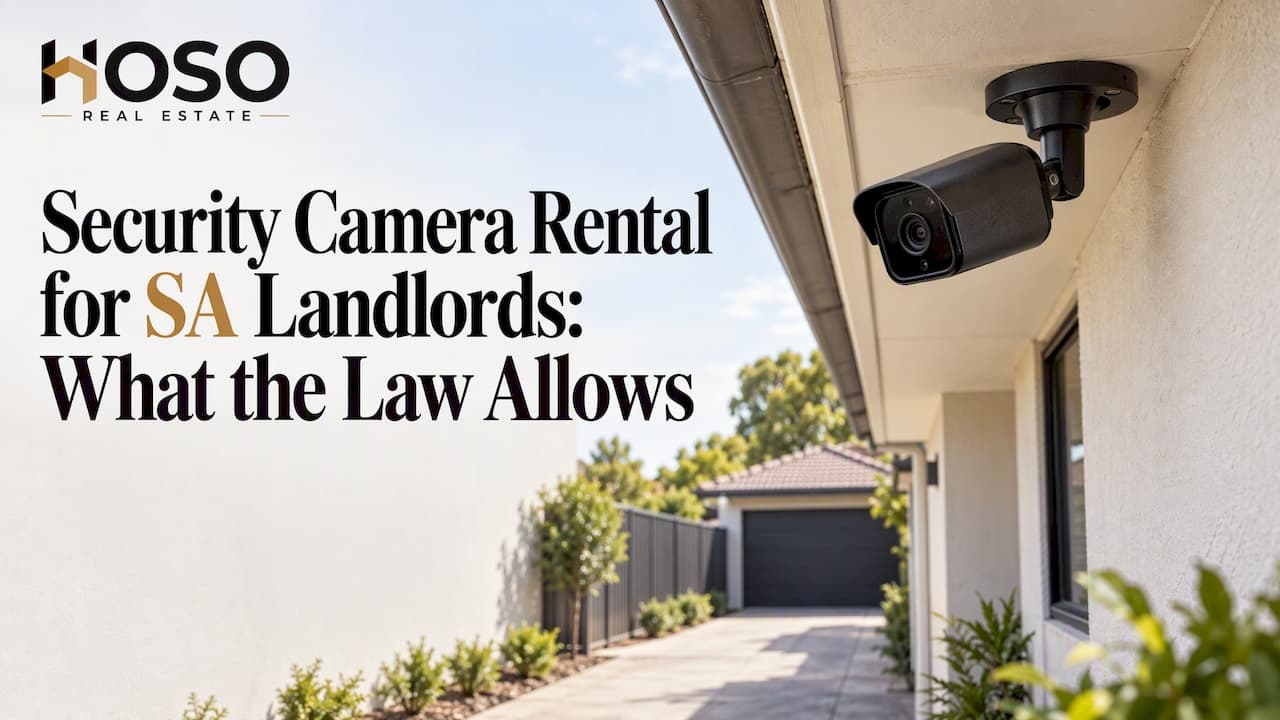
Renting security cameras can suit a vacant Adelaide property, a renovation site or a property between tenancies. In South Australia, the cameras must protect your lawful interests in the property and must not record private activities or private conversations without consent. Tenants must keep their reasonable peace, comfort and privacy. Cameras do not belong inside a tenanted home. This guide covers what a rental setup includes, how to choose one, where cameras can point and how to stay compliant.
TL;DR
- Rented cameras are best suited to vacant properties, renovations and building sites, where 4G units can run without mains power or an internet connection.
- The Surveillance Devices Act 2016 (SA) restricts recording private activities and private conversations without consent. Penalties are serious.
- A landlord's duty not to interfere with a tenant's reasonable peace, comfort or privacy continues through the tenancy. Keep cameras to exterior and common approaches, and never inside.
- Before signing a rental agreement, confirm who installs, monitors, repairs and removes the equipment, and what mounting restrictions apply.
- Put camera arrangements in writing, tell tenants and your property manager, and keep your records tidy in case of a SACAT dispute.
Table of Contents
- When renting cameras makes sense for an Adelaide landlord
- What a camera rental typically includes
- Questions to ask before you sign a rental agreement
- South Australian law on cameras at rental properties
- Cameras and tenants: keeping peace, comfort and privacy
- Can a camera point at the neighbours?
- Vacant property, between tenancies: a sensible setup
- Interstate and overseas owners: rules differ by country
- Our perspective
- Work with a manager who protects the asset
- FAQ
- Sources
When renting cameras makes sense for an Adelaide landlord
Most landlords think of cameras as a permanent purchase. Renting is a different tool, and it suits a narrower set of situations.
Vacant periods. A property between tenants, or a home waiting on a sale or settlement, carries risks: break-ins, dumping, squatting and unauthorised access. Short-term cameras give you evidence and remote visibility without a permanent fixture.
Renovations and building works. Materials, tools and fittings are often the target. Providers of temporary surveillance describe turn-key 4G units for building sites, homes and businesses, with phone access to a 24-hour HD video stream and no need for mains power or internet. That matters on a vacant block or a house with the power disconnected during works.
Interstate and overseas owners. If you live in Sydney, Perth or abroad, you cannot pop over to check on a vacant property in Unley or Glenelg. Remote viewing gives you reassurance while the property is empty.
Short-term risk periods. Some owners want cameras only while a specific issue is being managed, such as repeated dumping at a rear lane or attempted entry at a recently vacated townhouse. A rental suits a defined problem with a defined end date.
If the property is tenanted, the picture changes. A tenant has the right to reasonable peace, comfort and privacy, and a camera inside the home is not appropriate. We cover that below.
What a camera rental typically includes
Rental models differ, so read the scope carefully. Providers commonly bundle several elements:
- Installation and configuration. Some providers send technicians who install and configure the cameras for you.
- Connectivity. Cellular units connect over 4G, which suits properties without a working internet service.
- Monitoring. Basic rentals give you a live app view. Managed services add live monitoring, and verified alarms may prompt audio warnings or the dispatch of law enforcement.
- Maintenance and faults. One rental provider states that its service includes equipment care and replacement for faults and normal wear. Others offer remote diagnostics and support.
- Collection at the end. Someone has to remove the units and make good any fixings.
There is also a difference in philosophy. Traditional cameras were for after-the-fact investigation. Managed surveillance, as VSI Technology explains, uses real-time analytics and human operators to intervene while an event is happening. For a vacant property, the second approach is closer to what you actually want: a problem stopped, not just recorded.
Do cameras deter intruders?
One provider reports that, in its experience, well-placed cameras usually deter small groups from entering a building site, likening them to barking dogs. That is the provider's own view, not independent research. Treat cameras as one layer alongside locks, lighting, mail collection and regular inspections.
Questions to ask before you sign a rental agreement
A short checklist saves disputes later.
- Who installs and removes the equipment? Confirm that qualified technicians do the work and that removal is included in the scope.
- What are the mounting restrictions? Rental providers advise property managers to clarify mounting restrictions and cable routing paths to avoid property damage during installation and removal. This matters on older Adelaide stone cottages and heritage-listed façades, where drilling can cause lasting damage.
- How is footage stored and who can access it? Know where recordings are held, how long, and who holds the login. You are responsible for what is captured.
- Can the field of view be masked or adjusted? You may need to block out a neighbour's window or yard. Ask whether privacy masking is built in.
- Does the unit record audio? Audio is where most legal trouble starts. Where possible, disable it.
- What happens in a fault? Ask about remote diagnostics, replacement and response times. One provider says a remote reboot can resolve up to 99% of the issues its health checks detect, which is a claim worth asking any provider to substantiate for its own system.
- What is the agreement length? Temporary site rentals can be short or open ended. Fixed systems may run on 24 or 36 month agreements, which is a poor match for a vacancy that may last a few weeks. Match the term to your need.
- Is anything in your strata, council or body corporate rules relevant? The OAIC advises checking local council rules and strata by-laws before installing cameras.
We do not recommend any particular provider. Choose on scope, support and the conditions above.
South Australian law on cameras at rental properties
This is where landlords get caught out. Rented or owned, the same rules apply to the camera.
The Surveillance Devices Act 2016 (SA)
The Act regulates listening devices, optical surveillance devices and tracking devices. In general, it prohibits using an optical surveillance device on premises or a vehicle to visually record or observe a private activity without the consent of all principal parties. It also generally prohibits recording a private conversation without the consent of all principal parties.
The penalties are not minor. The South Australian Legal Services Commission states that contraventions can attract a fine of up to $15,000 or imprisonment for up to three years for an individual, and a fine of up to $75,000 for a body corporate.
The lawful interest exception
The Act contains exceptions. These include protecting a person's lawful interests or serving the public interest, assessed against competing privacy interests. In practice, a landowner may install CCTV without a neighbour's consent, even if the neighbour's private activities may be within range, where the cameras are directed to protect the landowner's lawful interests in the property. The test is objective. A camera aimed at your own front door and driveway sits comfortably inside it. A camera aimed at a neighbour's pool does not.

The new statutory tort
From 10 June 2025, Schedule 2 of the Privacy Act 1988 (Cth) lets a person sue for a serious invasion of privacy, including intrusion upon seclusion such as watching or recording private activities. That adds a civil risk on top of the state offences.
The federal Privacy Act
The OAIC says the federal Privacy Act does not cover a security camera operated by an individual in a private capacity, although state or territory laws may apply. Where the Act does cover the organisation operating a camera, it must tell people before recording that their image may be captured, secure the information, and destroy or de-identify it when no longer needed. If an agency, company or trust operates the cameras, take advice on whether those obligations apply.
Audio: the question landlords ask most
Is it legal to record audio on a security camera in Australia? In South Australia, recording a private conversation generally requires the consent of all principal parties. The safest approach for a rental property is to use cameras with audio disabled. Footage of a quiet driveway does not need sound, and sound is where a lawful security measure turns into a legal problem.
Cameras and tenants: keeping peace, comfort and privacy
Once a tenant moves in, the property is their home. Under section 65 of the Residential Tenancies Act 1995 (SA), a landlord must not cause or permit interference with the tenant's reasonable peace, comfort or privacy, and must take reasonable steps regarding interference by adjacent tenants.
For investors, this leads to a few practical rules:
- No cameras inside a tenanted property. Not in living areas, bedrooms, bathrooms or hallways. Hidden devices are the fastest route to a serious dispute.
- Be careful with exterior cameras. A camera covering a shared driveway or a front entry is different from one covering a tenant's private courtyard or backyard. A tenant's private outdoor space carries a reasonable expectation of privacy.
- Tell the tenant in writing. Disclose any camera before the tenancy starts, state where it points and what it records, and confirm audio is off. Surprises create complaints.
- Do not use footage to monitor the tenant. Cameras protect the asset. They are not a way to watch how a tenant lives.
- Use inspections for condition checks. Routine inspections are the proper mechanism. See our guide to routine inspection photos and consent in SA and our wider guide to tenant privacy laws in SA.
If a disagreement does escalate, it can end up before SACAT. Written notice, a clear camera position and a record of consent put you in a much stronger position than an informal arrangement.
Can a camera point at the neighbours?
It depends on what it captures and why. Incidental capture of a neighbour's property is unlikely to be considered a serious invasion of privacy, with camera angle, target and frequency deciding how serious an intrusion is. Deliberate, targeted surveillance of a private space such as a backyard, bedroom or courtyard is the high-risk scenario.
Practical steps:
- Angle cameras down and towards your own entry points, fences and driveway.
- Use privacy masking to block out neighbouring windows and yards.
- Avoid wide-angle views that sweep across adjoining properties.
- Keep a record of why each camera is positioned as it is. If the question ever arises, your reasoning should be about protecting the property.
This matters especially in Adelaide's denser areas, such as townhouses in Prospect or Norwood, and units in the CBD fringe, where boundaries are tight and neighbours are close. If you own a unit or townhouse, check the strata or community title rules as well.
Vacant property, between tenancies: a sensible setup
The period between tenancies is where rented cameras make the most sense, and where the privacy risk is lowest because nobody is living there. A sensible approach:
- Complete the exit inspection and take dated condition photos before the cameras go up.
- Position cameras at entries and on approaches, not pointed through windows at neighbours.
- Combine cameras with physical measures: secure locks, lighting, cleared mail and a regular visit by your property manager.
- Remove the cameras before the next tenant moves in, or disclose any that remain.
- Confirm the property is ready: see our Adelaide rental compliance requirements before you re-list.
If you are re-leasing quickly, a rental appraisal helps you plan the vacant period realistically. You can request a rental appraisal from our team.
Interstate and overseas owners: rules differ by country
If you own property in more than one jurisdiction, remember that camera law does not travel. South Australian rules apply to your Adelaide property regardless of where you live. Other countries handle the question differently, and a look at video surveillance legislation in Bulgaria shows how another legal system frames the same questions of consent and privacy. Never assume that a setup that is lawful in another country, or in another Australian state, is lawful in Adelaide.
Our perspective
We manage Adelaide rental properties, and we see the same pattern with cameras. An owner worries about a vacant property, buys or hires equipment quickly, and only later asks what the law says about where it can point.
Our view is that cameras are a useful short-term tool for a vacant property, and a poor substitute for good management. Asset protection comes from a stack: careful tenant selection, regular inspections, prompt maintenance and clear communication. Cameras sit on top of that, not in place of it.
We built our approach around exactly that stack. Our tenant screening uses a 4-layer system, and we offer a drug testing service for owners who want it. A 24/7 owner portal gives you visibility of your property without needing your own surveillance. We focus only on property management, not sales, so your portfolio is the whole job.
If you are considering cameras, tell us before you install them. We will check the position against South Australian requirements, make sure any tenant is notified in writing, and keep the documentation in order.
HOSO
Work with a manager who protects the asset
If you want visibility without the legal risk, we can help. HOSO Real Estate provides full property management, tenant placement, rent collection, maintenance management, lease administration and property inspections for Adelaide landlords, with HPTS tenant screening and a drug testing service available. Explore our property management services or start at hoso.com.au to talk to us about your property.
Our property management agreement also comes with a 60-day satisfaction guarantee.
FAQ
Is it legal to record audio on security cameras in Australia?
In South Australia, recording a private conversation generally requires the consent of all principal parties under the Surveillance Devices Act 2016. Penalties for breaches can reach a $15,000 fine or three years' imprisonment for an individual. The safest approach on a rental property is to disable audio entirely.
Can I put security cameras inside a tenanted rental property?
No, we do not recommend it. Section 65 of the Residential Tenancies Act 1995 (SA) requires landlords not to interfere with a tenant's reasonable peace, comfort or privacy. Cameras inside the home would also risk breaching surveillance law. Keep any cameras to external entry points and disclose them to the tenant in writing.
Can a security camera point at my neighbour's property?
Incidental capture is unlikely to be treated as a serious invasion of privacy. Deliberately aiming at a neighbour's backyard or other private space is high risk under both the Surveillance Devices Act and the new statutory tort. Use privacy masking and angle the camera at your own property.
Are rented cameras suitable for a vacant house?
Yes, that is one of the best uses. Cellular units can run without mains power or internet, which suits a house between tenancies or under renovation. Pair them with locks, lighting and regular inspections, and remove them before a new tenant moves in unless you have disclosed them.
Do I need to tell my tenant about cameras?
Yes, as good practice and to protect your position if a dispute arises. State where each camera is, what it covers and that audio is off, in writing, before the tenancy begins. Talk to your property manager first so the details are recorded properly.
Sources
- Security Camera Rental & Hire, Hypervision
- Construction Site CCTV Cameras, Hypervision Security
- Temporary CCTV Camera Hire, WCCTV
- CCTV Security Camera Surveillance Hire & Rental, Parkland Australia
- Camera Rental FAQ, Kilo
- VSI Technology FAQ
- Recording private conversations or activities, Legal Services Commission SA
- Lawful interest and public interest exceptions, SA Law Handbook
- Statutory tort for serious invasions of privacy, Legal Services Commission SA
- Security cameras, OAIC
- The landlord's obligations, SA Law Handbook
- Neighbour Camera Pointing at My House, Privacy Lawyer
- Video surveillance legislation in Bulgaria, Stivo.bg