
Before anything else, confirm three things: the tenant has received written notice of the change of manager, the bond details and lodgement record are in hand, and you have a current rent ledger snapshot. Everything else in a property management handover, from inspection reports to keys, follows once those three are verified. South Australian compliance around tenant notice and bond handling is covered in detail below.
TL;DR:
- Proper documentation verification includes confirming the tenant has received written notice of the management change within 14 days, with proof retained; missing or unverified notices increase legal risks.
- The exit condition report must match the entry report exactly, with photos timestamped before cleaning or repairs, to hold up in a bond dispute or tenant claim.
- Confirming bond details through independent checks and reconciling the rent ledger against bank statements helps prevent surprises during bond claims or disputes.
- Maintaining a full maintenance history, including open work orders and contractor contact details, is essential for safe management transition and safety compliance.
- Conducting a structured, step-by-step handover process within two weeks, with clear owner responsibilities and written summaries, minimizes gaps and protects landlord assets.
Table of Contents
- What is a property management handover, and what has to transfer?
- How do you verify condition reports and photo evidence?
- Confirming bond status and reconciling the rent ledger
- What are your tenant notice and privacy obligations?
- Handing over maintenance history and keys
- What's the step-by-step handover timeline?
- How HOSO Real Estate runs a handover in practice
- Why an organised handover is asset protection, not paperwork
- Let HOSO Real Estate manage your next handover
- Sources
- FAQ
What is a property management handover, and what has to transfer?
A property management handover is the formal transfer of a rental property's legal, financial, and operational records from one managing agent (or from self-management) to another. It is not a courtesy email and a set of keys. It is a documented handback of everything that proves who is responsible for the tenancy, what condition the property was in, and what money has moved.
Done properly, it protects you if a dispute lands at SACAT months later. Done poorly, it leaves gaps that surface at the worst possible time, usually at bond disposal or when a tenant disputes a condition claim.
The documents below form the backbone of any handover pack:
- Tenancy agreement and any signed variations or renewals
- Entry condition report with matching photographs
- Bond lodgement confirmation, including the bond number
- Rent ledger showing payment history and any arrears
- Notices issued to the tenant, including the written notice of change under s48 of the Residential Tenancies Act 1995 (SA)
- Maintenance and repair records, including outstanding work orders
Check whether each document is an original or a scanned copy, and look for signatures and dates that match the tenancy timeline. If something is missing, contact the outgoing manager or the previous landlord directly and log the gap in writing. Don't rely on a verbal assurance that "it's fine" or "it was handled."
How do you verify condition reports and photo evidence?
An exit condition report is only useful if it can stand up in a dispute. It should mirror the entry report room by room, carry a timestamp, and include photos taken before any cleaning or repairs began, since that sequencing is what gives bond claims their weight.
Run through this sequence when auditing a handover's evidence pack:
- Confirm the exit report covers every room listed in the entry report, not just the "problem" areas.
- Check that photos are dated and match the report's room-by-room notes.
- Look for signs of post-cleaning photography, such as unnaturally tidy carpets or freshly painted walls that don't match earlier notes.
- Verify the tenant was given a copy of the exit report, as required for it to hold up as evidence.
Photos taken after cleaning or repairs carry far less weight in a bond dispute, because they no longer show the property's actual condition at vacate.
Pro Tip: Open the photo files and check the metadata, not just the filenames. A timestamp embedded in the image file is harder to dispute than a folder labelled "exit inspection."

Confirming bond status and reconciling the rent ledger
Bond details need independent verification, not just a number handed over in an email. Confirm the bond reference through Residential Bonds Online using the property address and tenant name, and cross-check it against the amount stated in the tenancy agreement.
On handover day, work through this:
- Pull a full rent ledger printout showing every transaction, not a summarised balance.
- Reconcile the ledger against bank statements for at least the last three months.
- Flag any arrears immediately and confirm whether a notice has already been issued.
- If a bond claim is likely, start compiling quotes, invoices, and photos now, since conciliation moves faster with complete evidence on the table.
Bond claims lodged with itemised invoices and matching photos are far more likely to resolve at conciliation stage rather than escalating to a hearing.
What are your tenant notice and privacy obligations?
The tenant has a legal right to know who is managing their tenancy. Under s48 of the Residential Tenancies Act, a new landlord must ensure the tenant receives written notice of the change, including updated contact details, within 14 days of taking over.
Keep proof of delivery, whether that's a signed acknowledgement or a timestamped email, because "we told them" is not evidence if it's ever challenged.
- Confirm in writing that the tenant has been notified of the new manager and contact details.
- Check whether the outgoing agent used a tenancy database, and if so, ensure the tenant was told which one.
- Under Part 5A of the Act, tenants must be able to request a copy of any information listed about them, and agents cannot charge for providing it from 1 July 2024.
- Record the date and method of every notice sent during the transition.
Recent SA rental reforms have pushed penalties for breaches of tenant-notice and tenancy database rules up to $35,000, making this one of the highest-risk areas in a handover if it's skipped or rushed.
Handing over maintenance history and keys
Outstanding work orders don't disappear when the managing agent changes. Request a full maintenance history, including anything mid-repair, contractor names and numbers, and a clear flag on anything safety-related, like a smoke alarm fault or a gas leak report.
- Get a written list of open work orders with dates lodged and current status.
- Confirm whether existing trades will continue, or whether new suppliers need briefing before the next call-out.
- Cross-check contractor invoices against the maintenance log to catch anything paid but not completed.
- Record every key, fob, and remote handed over, and who holds spares.
Pro Tip: If the property has digital access (smart locks, intercom apps), reset all codes and revoke old user access on handover day, not "sometime this week." A lingering access credential is a liability nobody remembers until it matters.
What's the step-by-step handover timeline?
A handover works best as a fixed sequence rather than an open-ended process that drifts for weeks.
- Day 0: Verify tenant notice has been issued, confirm bond reference, and collect the tenancy agreement and entry report.
- Days 1 to 7: Reconcile the rent ledger, request the maintenance history, and audit the exit and entry inspection reports against each other.
- Days 8 to 14: Confirm key handover and access resets, finalise any outstanding notices, and log unresolved items with a named owner and follow-up date.
- Close-out: Issue a written handover summary to the landlord confirming every document, financial position, and open item.
Track this on a simple checklist:
- Documents transferred and verified
- Bond confirmed via Residential Bonds Online
- Tenant notice delivered and proof retained
- Maintenance items logged with status and owner
- Keys and access confirmed and reset
Anything not resolved by close-out gets an owner and a date, not a shrug.
How HOSO Real Estate runs a handover in practice
HOSO Real Estate treats day one as an audit, not a formality. On the first day, we request the full document set, bond record, and rent ledger, then cross-check every exit photo against the entry report before accepting the file as complete.
Our checklist mirrors the process above but with tighter evidence standards: no report accepted without matching timestamps, no ledger accepted without a bank reconciliation..
Why an organised handover is asset protection, not paperwork
Most handover failures come down to one thing: someone assumed a document existed because it should have, rather than confirming it did. That assumption costs landlords real money when a bond claim falls apart for lack of dated photos, or a tenant dispute drags on because nobody can prove notice was given.
Professional oversight closes that gap because it treats each document as evidence, not admin. Every handover should be run as a formal process with sign-off, not a courtesy handshake between agents.
— HOSO
Let HOSO Real Estate manage your next handover
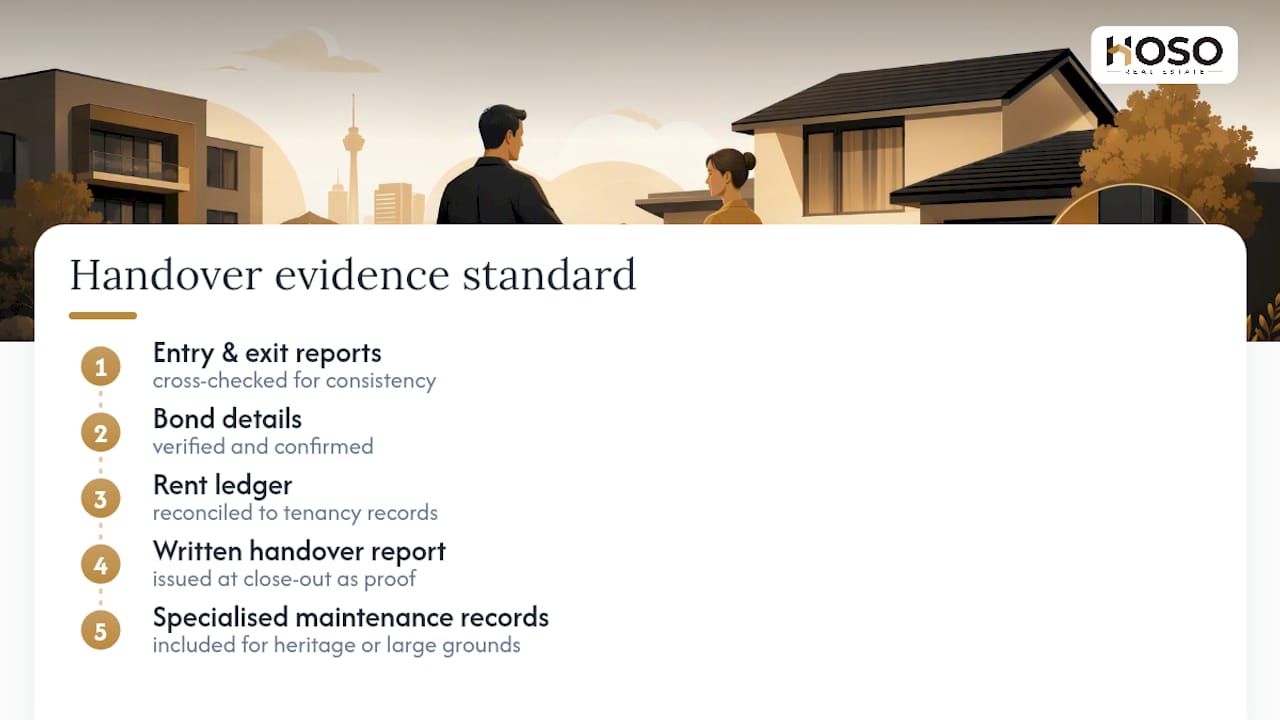
HOSO Real Estate is the alternative to a rushed, informal handover for Adelaide landlords who want a documented, tribunal-ready transition rather than a folder of loose files. We run every takeover against a fixed evidence standard: entry and exit reports cross-checked, bond details confirmed, rent ledger reconciled, and a written handover report issued to you at close-out, so you have proof of the property's position on day one, not a guess.
For landlords with heritage properties or larger grounds, this approach also accounts for specialised maintenance records that a standard handover often misses, as outlined in our common heritage house problems inspection guide.
If you're taking over management of a property in Norwood, Glenelg, or anywhere across Adelaide, get in touch through our property management services page to arrange a handover consultation.
Sources
- Residential Tenancies Act 1995 (SA) s48 — AustLII
- Exit Condition Report SA — ConditionHQ
- Law Society / Legal Services Commission handbook — residential tenancy databases
- Law Handbook — resolving tenancy disputes (SACAT)
FAQ
What is the biggest challenge in a property management handover?
The biggest challenge is verifying that documents and evidence actually exist and match, rather than assuming they were handled by the previous manager. Missing timestamps, unmatched entry and exit photos, and unconfirmed tenant notices are the most common gaps.
What are the steps involved in the handover process?
The core steps are document collection and verification, condition report auditing, bond and rent ledger reconciliation, tenant notification, maintenance and key transfer, and a formal close-out with a written summary. Each step should be completed within a set timeframe, typically across the first 14 days.
How long does a landlord have to notify a tenant of a new manager?
Under s48 of the Residential Tenancies Act 1995 (SA), a new landlord must ensure the tenant receives written notice of the change, including new contact details, within 14 days of the succession.
What happens if a bond dispute goes unresolved?
Unresolved bond disputes in South Australia typically proceed to SACAT, which can order bond distribution, compensation, or possession, and agents commonly represent landlords at these hearings.
Can HOSO Real Estate manage the handover process for me?
Yes. HOSO Real Estate runs handovers as a documented audit, checking every entry and exit report, bond record, and rent ledger before accepting a file as complete, then issuing a written handover report to the landlord.