
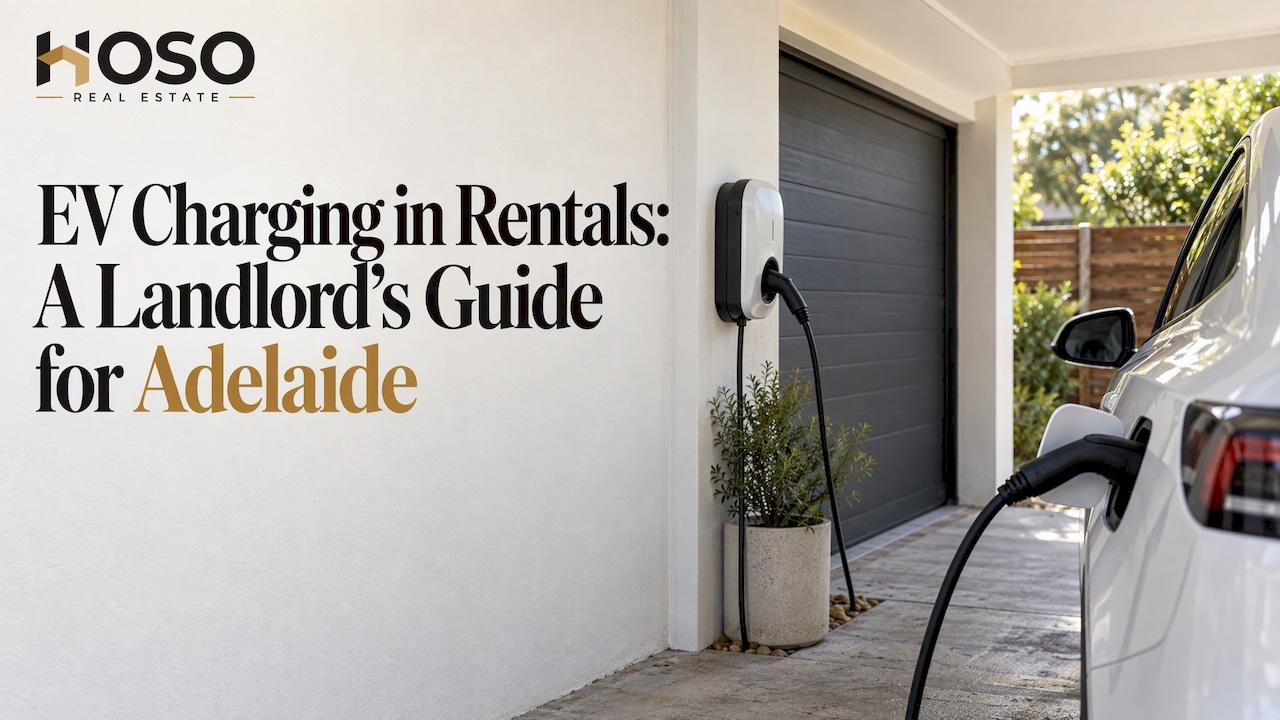
A tenant who drives an electric vehicle will sooner or later ask to charge it at your property. The safest answer is a written, conditional approval: a licensed electrician does any fixed wiring, you approve the location in writing, and the agreement states who owns the charger and what happens to it when the lease ends. A tenant who only plugs into an existing outlet needs a much simpler conversation. At HOSO Real Estate we manage Adelaide rentals, and this is how we would set the request up so the asset stays protected.
TL;DR
- A standard power point can charge an EV slowly, which covers typical daily driving. A dedicated wall charger is faster but is a fixed electrical installation.
- Under South Australian tenancy rules, a tenant needs your consent before altering the premises. Give any approval for a hardwired charger in writing.
- Fixed wiring must be done by a licensed electrician, and you should keep the compliance paperwork on file.
- For units and townhouses, you also need the strata or community corporation to agree before you do.
- Settle ownership, maintenance, insurance and removal in writing before the first cable is run.
Table of Contents
- What EV drivers actually need from a rental
- When a tenant just plugs in
- Consent for a hardwired charger in South Australia
- What a good approval looks like
- Who pays and who owns
- Units, townhouses and strata
- Solar and charging costs
- If a charger is not possible
- Why EV-ready rentals attract better tenants
- Our perspective
- How HOSO can help
- Frequently asked questions
- Sources
What EV drivers actually need from a rental
Most tenants are not asking for a commercial-grade charging station. Many simply want to know whether they can charge overnight at the property.
The federal government's guide to charging an electric vehicle explains there are two broad home options. The first is plugging a cable into a standard outlet, known as Level 1 charging. It tops out at 2.4 kW and can take up to 24 hours to fill a battery from empty. The same guide notes that the average Australian driver covers about 33 km a day, so overnight charging from a standard outlet can meet ordinary daily driving.
The second option is a dedicated home charger. The guide says these normally supply 7 to 22 kW, charge roughly 3 to 10 times faster than a standard outlet and may add about 30 to 80 km of range per hour. A dedicated charger is connected directly to the home supply, must be installed by a licensed electrician and may need a switchboard or supply upgrade.

For you as the landlord, that split matters. The first option uses infrastructure already in the property. The second changes the electrical system of an asset you own.
When a tenant just plugs in
The Electric Vehicle Council says a renter may charge from a nearby power point if the vehicle can be parked safely, but should obtain permission to use infrastructure owned by someone else. The Council's guidance on renters and apartments is a useful reference point for how the industry frames it.
In practice, the outlet is your property, so a short written note is sensible even for this simple case. It can cover:
- which outlet may be used, and that it must be in good condition
- that the cable must not run across a shared path or create a trip hazard
- that no extension leads or power boards are used for the charging cable
- that the tenant pays for the electricity they use
That last point is easier where the property has its own meter. In a unit sharing a common supply, the question of who pays for power needs to be answered before any approval is given.
The outlet condition is also worth checking before the tenancy starts. Our guide to Adelaide rental compliance requirements covers the safety baseline every South Australian rental needs, and a sound, documented electrical starting point makes any later charging request easier to assess.
Consent for a hardwired charger in South Australia
A wall charger is a different matter. The Consumer and Business Services Tenant Information Guide lists, among a tenant's obligations, not making alterations to the premises without the landlord's consent. It gives picture hooks, shelves and fences as examples. A fixed EV charger is a far bigger alteration than any of those.
So the starting position is clear: no installation without your agreement, and the agreement should be in writing. If you and a tenant disagree about a request, South Australian tenancy disputes are heard by SACAT, so it pays to keep a clean paper trail from the first email.
Other states have started to spell out EV charger rules in detail. For example, Queensland's tenancy authority treats a charger as a fixture and makes approval the owner's decision. Those are Queensland rules and do not apply here, but they show where the industry is heading. If you own property in South Australia, work to the South Australian rules and the current guidance from Consumer and Business Services.
What a good approval looks like
A landlord who says an unconditional yes takes on risk. A landlord who says a flat no may lose a quality tenant in a market where good tenants have options. The middle path is a conditional written approval. Include the following.
1. A licensed electrician's scope
The tenant should obtain a written quote from a licensed electrician. It should state the charger model, where it will be mounted, the cable route and any switchboard work. The federal guide is plain that a dedicated charger must be installed by a licensed electrician, and that switchboard or supply upgrades may be needed. Your approval should be limited to that scope.
2. Compliance paperwork
Ask for the electrician's compliance documentation once the work is done. The retrieved Western Australian guidance from an EV charging installer says completed fixed wiring should come with an electrical safety certificate. In South Australia the paperwork requirements are set by the state's technical regulator, so ask your electrician which certificate applies and keep a copy with the property file.
3. Location and impact on the building
Specify the exact wall, the mounting method and how any conduit or cable will be run. Ask that holes be sealed and surfaces made good if the charger is removed. Photographs before and after belong on file, and they fit naturally with your ingoing and routine inspection reports.
4. Ownership and removal
Decide whether the charger belongs to the tenant and is removed at the end of the lease, or stays and becomes yours. Each answer is valid. What matters is that it is written down. If it is removed, the agreement should say who makes good the wall and by when. If it stays, record the make, model and installation date so you know what you now own and maintain.
5. Insurance
Tell your insurer before approving a fixed installation, and ask whether anything changes for the building cover. Tenants should hold their own contents and vehicle insurance. Keep the insurer's response with the approval.
Who pays and who owns
The cost of a charger and its installation is usually the tenant's affair when the tenant asks for the work. The decision is yours, though, and you can reach a different arrangement if you want to attract a particular tenant or add a feature to the property. Whatever you agree, record it.
The federal strata guide gives a good model of what to cover. It says installation, ongoing maintenance and electricity costs for a personal charger may fall on the resident, depending on the arrangement agreed with the owners corporation. It also says decisions must address use, connection or disconnection, and what happens when a tenant or charger owner leaves. You can borrow that checklist for a freestanding house too:
| Item | Question to settle in writing |
|---|---|
| Installation | Who engages the electrician and who pays? |
| Electricity | Is the charger on the tenant's meter or a shared one? |
| Maintenance | Who repairs a faulty charger during the tenancy? |
| Ownership | Does it leave with the tenant or stay with the property? |
| Make good | Who repairs the wall and by when? |
| Insurance | Has the landlord's insurer been told? |
Units, townhouses and strata
If your investment is a unit, the question gets bigger. The car space, the wall and the power supply may sit on common property, and you cannot approve what you do not control.

The federal guide to personal chargers in strata buildings says a tenant must first obtain the landlord's approval, after which the landlord can act with the owners corporation, working through the strata manager. It adds that state and territory strata laws govern changes to shared property, and that approval thresholds for special-resolution processes typically range from 50% to 75% of owners.
That means a tenant's request becomes your project. Allow time for the corporation's process, and do not tell a tenant they can proceed until the corporation has agreed. Our guide to strata by-laws and rentals in South Australia explains how by-laws affect what you can approve, and it is worth reading before you reply to a charging request in a unit.
Solar and charging costs
Many Adelaide homes already have rooftop solar, and tenants with EVs often like the idea of charging in daylight hours. If your property has solar, think about how that interacts with the tenancy, including who benefits from the generation and any feed-in arrangements. Our guide to solar feed-in tariffs on SA rental properties covers the landlord's side of that question.
If a charger is not possible
Sometimes the answer has to be no, for instance when a unit's corporation declines or the switchboard cannot take the load. A clear, reasoned reply protects the relationship. You can point out that standard-outlet charging, where you permit it, may cover daily driving. The Electric Vehicle Council also reports that for most Australians one fast charge per week at a public charger may fulfil average travel needs.
In South Australia, the RAA runs a public network. RAA Charge lists more than 140 charging locations across the state, which gives tenants an option when home charging is not available. The Conversation has also reported that kerbside chargers are needed for renters and apartment residents without off-street parking, offering charging in 2 to 8 hours depending on the charger and vehicle, so public charging infrastructure is still growing.
Why EV-ready rentals attract better tenants
EV owners tend to plan their housing around where they can charge. A property that has a clear, documented process for charging requests is easier to market to them. That includes a short written policy, a pre-approved outlet where it is safe, and a set of conditions you apply consistently.
Tenant quality matters just as much as the charger. Any approval should sit on top of a thorough screening process, because you are trusting the tenant to keep a fixed installation in good order. Documenting the charger at each routine inspection is a simple way to keep that trust verifiable.
Our perspective
An EV charger request is a good sign. It usually comes from a tenant who plans to stay, and who is investing in your property's usefulness.
The risk is not the charger. It is the missing paperwork around it: an informal yes in a text message, no electrician's certificate, no record of who owns the unit on the wall. We handle residential property management in Adelaide with the owner's position in mind, so a request like this becomes a short written process rather than an open question.
Our approach is to keep landlords informed through a 24/7 owner portal, to document the property through routine inspections, and to coordinate maintenance and compliance so approvals and records sit in one place. We screen applicants through our 4-layer tenant screening system, which is designed to put the right people into your property before any question of alterations arises.
HOSO
How HOSO can help
If you own a rental in Adelaide and a tenant has asked about charging, we can help you respond properly. We focus exclusively on property management, not sales, and our services cover full property management, tenant placement, maintenance management and property inspections. If you are considering adding EV-ready features to attract a tenant, a rental appraisal is a sound starting point for understanding how the property sits in the market.
Frequently asked questions
Can my tenant charge an EV from a normal power point?
Technically yes. The federal guide says an EV can be charged from a standard outlet using an appropriate cable, at up to 2.4 kW. You should still give permission for the specific outlet in writing, and set conditions about cable safety and electricity costs.
Does a tenant in South Australia need my permission to install a wall charger?
Yes. The Consumer and Business Services tenant guide says tenants must not make alterations to the premises without the landlord's consent. Give your approval in writing, and attach the conditions you require.
Who should install the charger?
A licensed electrician. The federal guide states that a dedicated charger is connected directly to the home supply and must be installed by a licensed electrician. Keep the compliance documentation with the property records.
What if the property is a unit?
You will need the owners corporation to agree as well. The federal strata guide says the tenant must first obtain the landlord's approval, after which the landlord acts with the corporation. Approval thresholds for special resolutions typically range from 50% to 75% of owners.
What happens to the charger when the tenancy ends?
That depends on what you agreed in writing. Either the tenant removes it and makes good the wall, or it stays with the property. State this in the approval so there is no dispute at the final inspection.
Sources
- How to charge your electric vehicle, energy.gov.au
- Installing a personal EV charger for strata building residents, energy.gov.au
- Are there options for charging an electric vehicle in apartments or homes without a personal garage, Electric Vehicle Council
- Tenant Information Guide, Consumer and Business Services SA
- Australia needs thousands more kerbside EV chargers, The Conversation