
Most landlords sign a property management agreement and assume the rest takes care of itself. It rarely does. Understanding what is property management service level, and more precisely what a Service Level Agreement (SLA) commits your manager to in measurable terms, is the difference between a passive arrangement and one that actually protects your investment. This guide breaks down service level definitions, the metrics that matter, how different property management levels compare, and how to negotiate terms that work in your favour.
Table of Contents
Key takeaways
| Point | Details |
|---|---|
| SLAs define measurable standards | A property management SLA specifies response times, resolution rates, and reporting frequency, not just general duties. |
| Service tiers vary significantly | Full-service and partial management differ in scope, authority, and tenant communication coverage. |
| Metrics and remedies matter | Without measurable targets and consequences for shortfalls, an SLA offers little practical protection. |
| Authority limits affect outcomes | Spending thresholds in agreements directly impact how quickly your manager can resolve maintenance issues. |
| Active monitoring is required | Reviewing owner reports, portal timestamps, and escalation records keeps service levels accountable over time. |
What property management service level means
The phrase “property management service level” is widely used but rarely defined clearly. The industry standard term is a Service Level Agreement, or SLA. An SLA specifies how well services must be delivered and how performance is measured, going well beyond a general management contract that simply lists duties.
A standard property management contract tells you what your manager will do. An SLA tells you how well and how fast they must do it. That distinction matters enormously when things go wrong.
Understanding property management services at this level means recognising three core layers:
-
Scope of services. What functions the manager is responsible for, such as tenant leasing, routine inspections, maintenance coordination, rent collection, and compliance management.
-
Performance standards. The measurable benchmarks attached to each function, for example, responding to a maintenance request within four business hours.
-
Accountability mechanisms. What happens when a standard is not met, including escalation procedures, fee reductions, or contract review rights.
A property maintenance SLA is legally binding, which increases trust and reduces disputes by setting clear expectations and remedies. This is not a vague promise. It is a documented commitment with consequences.
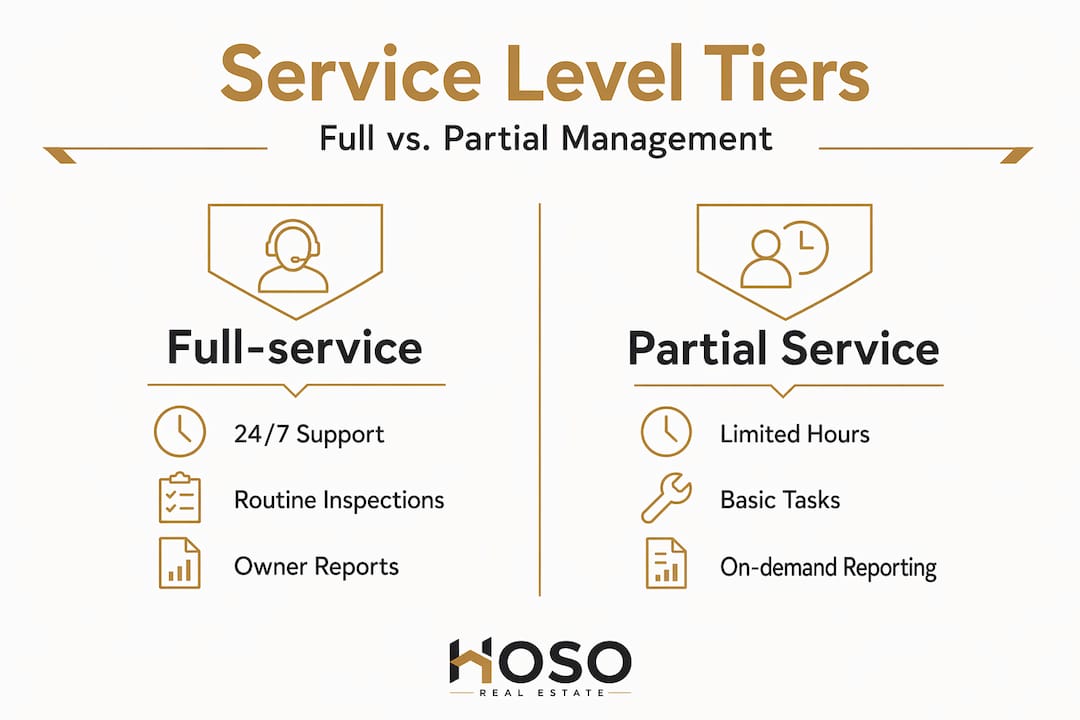
Property management levels also refer to service tiers. Full-service management includes operational pillars such as 24/7 tenant communication, issue resolution, and owner reporting. Partial or limited service covers fewer functions, typically leasing only or maintenance only, leaving other responsibilities with the owner.
SLA components and measurable metrics
Once you understand what an SLA is, the next step is knowing which components actually determine service quality. Not all agreements are built the same way, and the gaps are often where service failures occur.
The core components of a well-structured property management SLA include:
-
Scope definition. A precise list of included services with no ambiguous language about what falls inside or outside the agreement.
-
Performance metrics. Specific, quantified targets such as time-to-acknowledgement, time-to-resolution, and reporting frequency.
-
Escalation procedures. A documented process for what happens when a request is not resolved within the agreed timeframe.
-
Remedies and consequences. Fee credits, contract review rights, or other remedies that activate when targets are missed.
On maintenance specifically, tracking stage-by-stage timestamps helps verify SLA compliance and identify delays. The SLA clock starts the moment a work order is submitted, not when a tradesperson is booked. Time-to-acknowledgement and time-to-resolution are two distinct KPIs, and both should appear in your agreement.
Reporting frequency is another metric owners often overlook. Clear written agreements and regular owner communication build service level clarity and enforceability. Monthly statements are standard, but quarterly condition reports, maintenance summaries, and tenancy renewal notices should also be specified with timeframes.
Pro Tip: When reviewing an SLA, check whether each metric has a defined measurement method. “We respond promptly” is not a metric. “We acknowledge all maintenance requests within four business hours, confirmed by system timestamp” is.
Measurable metrics with remedies activate escalation procedures when targets are missed, holding providers accountable in a way that vague language never can. If your current agreement lacks this specificity, that is the first thing to address.
Comparing property management service levels
What does property management include at each service tier? The answer depends heavily on the arrangement you have in place. The table below compares the two most common service structures.
| Feature | Full-service management | Partial or limited management |
|---|---|---|
| Tenant communication | 24/7, all channels handled | Limited hours or owner-managed |
| Maintenance coordination | End-to-end, including contractor management | Reactive only, or owner-arranged |
| Routine inspections | Scheduled and documented | May not be included |
| Rent collection and arrears | Fully managed with escalation | Partial, owner follows up |
| Owner reporting | Regular financial and condition reports | Minimal or on-request only |
| Compliance management | Proactive, including legislative updates | Owner-responsible |
| Leasing and tenant selection | Full marketing, screening, and placement | Leasing only, no ongoing management |
Full-service management is not simply “more tasks.” The distinction is authority and continuity. A full-service manager acts on your behalf within agreed spending limits, resolves issues without requiring your sign-off on every decision, and maintains consistent communication with tenants regardless of time or day.
Service quality can be undermined if managers lack authority to perform repairs below certain thresholds without owner approval. A $500 maintenance threshold requiring owner sign-off sounds reasonable until a plumbing issue escalates over a weekend because approval was delayed. Setting a realistic maintenance authority limit, typically between $500 and $1,500 depending on your property type, is one of the most practical decisions you can make.
Staffing and workload ratios also affect service quality in ways that are not visible in the agreement itself. Higher units-per-employee ratios can dilute service quality despite identical nominal packages. Ask any prospective manager how many properties each portfolio manager handles. A ratio above 150 properties per manager is a signal worth noting.
Negotiating and applying service levels
Understanding property management service details is one thing. Applying that knowledge when negotiating or reviewing an agreement is where it becomes useful. Here is a practical process for property owners.
-
Audit your current agreement. Identify every service listed and check whether a measurable standard is attached to it. If a service has no metric, it has no accountability.
-
Set your maintenance authority limit deliberately. Decide on a realistic threshold that allows your manager to act without delay, while still protecting you from unauthorised large expenditure.
-
Specify communication channels and response standards. Consolidate all tenant and owner requests through a single system. Automated acknowledgements within 60 seconds and proper routing are foundational for maintaining service levels and preventing requests from being missed.
-
Request access to an owner portal. A portal with real-time maintenance tracking, financial reporting, and document storage lets you verify SLA compliance without relying on manual updates.
-
Define escalation paths in writing. If a maintenance request is not acknowledged within four hours, who is notified? If it is not resolved within 48 hours, what happens next? These steps should be documented, not assumed.
-
Review performance quarterly. Use reports and portal data to check whether agreed metrics are being met. A pattern of minor shortfalls often precedes larger service failures.
Pro Tip: Ask your property manager to show you a sample owner report before signing. A manager who cannot produce a clear, timestamped maintenance and financial summary is unlikely to deliver SLA-level accountability once you are a client.
One commonly overlooked detail is what happens at lease renewal. Many SLAs are silent on the timeframe for renewal notices or rent review recommendations. Add a specific clause requiring written notification at least 60 days before lease expiry.
Challenges in maintaining service levels
Even well-written SLAs encounter real-world friction. Knowing where service levels typically break down helps you monitor for problems before they escalate.
Common failure points include:
-
Channel sprawl. Tenants contact managers via text, email, phone, and social media. Without a consolidated system, requests get lost and SLA clocks never start.
-
Inconsistent communication. A manager who responds quickly during business hours but goes silent on weekends is not meeting a 24/7 service commitment, regardless of what the agreement says.
-
Contractor availability. Maintenance SLAs depend on tradesperson availability. A manager with a reliable contractor network will consistently outperform one who relies on ad hoc bookings.
-
Staffing changes. When a portfolio manager leaves, their properties often experience a service gap. Ask how handovers are managed and whether SLA obligations carry through transitions.
-
Vague escalation paths. If the escalation procedure is “contact the office manager,” that is not a procedure. It is a suggestion.
When an SLA breach does occur, remedies should be proportionate and documented. A single delayed acknowledgement is different from a pattern of missed maintenance resolutions. Your agreement should distinguish between isolated incidents and systemic failures, with different remedies for each.
My take on what actually matters in service levels
I have worked with enough property owners to know that most do not read their management agreements carefully until something goes wrong. By then, the gaps in the SLA are no longer theoretical.
What I have found consistently is that two things determine whether a service level arrangement actually works in practice. The first is whether the metrics are specific enough to be verified. “We communicate regularly” is not a standard. “We send a written owner report by the fifth business day of each month” is. The difference seems small until you are three months into a tenancy with no updates.
The second is the maintenance authority limit. I have seen owners set limits so low that their manager cannot replace a broken tap without a phone call. That is not protection. That is delay built into the agreement. A realistic authority limit, paired with a clear escalation path for anything above it, is what actually keeps a property running without constant owner involvement.
The benefits of property management services only materialise when the agreement behind them has teeth. An SLA without measurable targets is just a list of intentions. Treat your service level arrangement as an active document, review it annually, and hold your manager to the standards you agreed on.
— Henry
Property management in Adelaide done properly
If you are reviewing your current arrangement or considering professional management for the first time, HOSO Real Estate offers transparent, measurable service across residential property management, leasing, maintenance coordination, and compliance. Every client receives access to a dedicated owner portal with real-time reporting, documented maintenance tracking, and clear communication standards built into the agreement from day one. HOSO Real Estate works with Adelaide landlords who want premium property management with defined service levels, not vague promises. Contact HOSO Real Estate to discuss a service arrangement tailored to your portfolio.
FAQ
What is a property management service level?
A property management service level is the agreed performance standard between a landlord and their property manager, typically formalised in a Service Level Agreement (SLA). It defines measurable benchmarks such as response times, reporting frequency, and maintenance resolution targets.
What does property management include at a full-service level?
Full-service property management includes tenant communication, maintenance coordination, routine inspections, rent collection, compliance management, and regular owner reporting. The manager acts with agreed authority to resolve issues without requiring owner sign-off on every decision.
How do I know if my SLA has measurable metrics?
Check whether each service in your agreement has a specific, quantifiable standard attached to it, such as a response time in hours or a reporting date each month. If a service is listed without a measurable target or remedy for non-performance, it is not an SLA metric.
What happens when a property manager breaches an SLA?
Depending on the agreement, a breach may trigger fee credits, a formal review process, or early termination rights. Well-structured SLAs distinguish between isolated incidents and repeated failures, with proportionate remedies for each.
How does a maintenance authority limit affect service levels?
A maintenance authority limit sets the maximum spend your manager can approve without your sign-off. Setting it too low creates delays in resolving issues, which can undermine SLA compliance and tenant satisfaction. A realistic threshold, typically between $500 and $1,500, allows faster resolution without removing owner oversight.